Advertisements
Advertisements
प्रश्न
Solve the following problem :
The percentage of girls’ enrollment in total enrollment for years 1960-2005 is shown in the following table.
| Year | 1960 | 1965 | 1970 | 1975 | 1980 | 1985 | 1990 | 1995 | 2000 | 2005 |
| Percentage | 0 | 3 | 3 | 4 | 4 | 5 | 6 | 8 | 8 | 10 |
Fit a trend line to the above data by graphical method.
Advertisements
उत्तर
Taking year on X-axis and percentage of enrolment on Y-axis, we plot the points for enrolment corresponding to years. Joining these points, we get the graph of time series. We fit the trend line as shown in the following graph.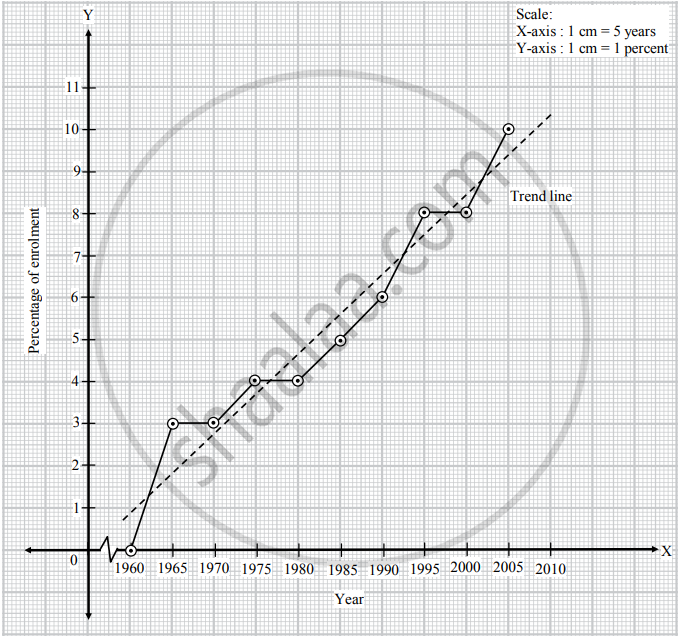
APPEARS IN
संबंधित प्रश्न
Obtain the trend line for the above data using 5 yearly moving averages.
Obtain the trend values for the above data using 3-yearly moving averages.
Choose the correct alternative :
We can use regression line for past data to forecast future data. We then use the line which_______.
Choose the correct alternative :
What is a disadvantage of the graphical method of determining a trend line?
Fill in the blank :
The method of measuring trend of time series using only averages is _______
State whether the following is True or False :
Least squares method of finding trend is very simple and does not involve any calculations.
State whether the following is True or False :
All the three methods of measuring trend will always give the same results.
Fit a trend line to the following data by the method of least squares.
| Year | 1974 | 1975 | 1976 | 1977 | 1978 | 1979 | 1980 | 1981 | 1982 |
| Production | 0 | 4 | 9 | 9 | 8 | 5 | 4 | 8 | 10 |
Solve the following problem :
Obtain trend values for the following data using 5-yearly moving averages.
| Year | 1974 | 1975 | 1976 | 1977 | 1978 | 1979 | 1980 | 1981 | 1982 |
| Production | 0 | 4 | 9 | 9 | 8 | 5 | 4 | 8 | 10 |
Solve the following problem :
Obtain trend values for the data in Problem 7 using 4-yearly moving averages.
Solve the following problem :
Fit a trend line to data in Problem 13 by the method of least squares.
Solve the following problem :
Following table shows the all India infant mortality rates (per ‘000) for years 1980 to 2010.
| Year | 1980 | 1985 | 1990 | 1995 | 2000 | 2005 | 2010 |
| IMR | 10 | 7 | 5 | 4 | 3 | 1 | 0 |
Fit a trend line to the above data by graphical method.
Solve the following problem :
Fit a trend line to data in Problem 16 by the method of least squares.
Solve the following problem :
Obtain trend values for data in Problem 16 using 3-yearly moving averages.
Choose the correct alternative:
Moving averages are useful in identifying ______.
State whether the following statement is True or False:
Least squares method of finding trend is very simple and does not involve any calculations
Following table shows the amount of sugar production (in lac tons) for the years 1971 to 1982
| Year | 1971 | 1972 | 1973 | 1974 | 1975 | 1976 |
| Production | 1 | 0 | 1 | 2 | 3 | 2 |
| Year | 1977 | 1978 | 1979 | 1980 | 1981 | 1982 |
| Production | 4 | 6 | 5 | 1 | 4 | 10 |
Fit a trend line by the method of least squares
Obtain trend values for data, using 4-yearly centred moving averages
| Year | 1971 | 1972 | 1973 | 1974 | 1975 | 1976 |
| Production | 1 | 0 | 1 | 2 | 3 | 2 |
| Year | 1977 | 1978 | 1979 | 1980 | 1981 | 1982 |
| Production | 4 | 6 | 5 | 1 | 4 | 10 |
Use the method of least squares to fit a trend line to the data given below. Also, obtain the trend value for the year 1975.
| Year | 1962 | 1963 | 1964 | 1965 | 1966 | 1967 | 1968 | 1969 |
| Production (million barrels) |
0 | 0 | 1 | 1 | 2 | 3 | 4 | 5 |
| Year | 1970 | 1971 | 1972 | 1973 | 1974 | 1975 | 1976 | |
| Production (million barrels) |
6 | 8 | 9 | 9 | 8 | 7 | 10 |
The following table shows the production of gasoline in U.S.A. for the years 1962 to 1976.
| Year | 1962 | 1963 | 1964 | 1965 | 1966 | 1967 | 1968 | 1969 |
| Production (million barrels) |
0 | 0 | 1 | 1 | 2 | 3 | 4 | 5 |
| Year | 1970 | 1971 | 1972 | 1973 | 1974 | 1975 | 1976 | |
| Production (million barrels) |
6 | 7 | 8 | 9 | 8 | 9 | 10 |
- Obtain trend values for the above data using 5-yearly moving averages.
- Plot the original time series and trend values obtained above on the same graph.
Obtain trend values for data, using 3-yearly moving averages
Solution:
| Year | IMR | 3 yearly moving total |
3-yearly moving average (trend value) |
| 1980 | 10 | – | – |
| 1985 | 7 | `square` | 7.33 |
| 1990 | 5 | 16 | `square` |
| 1995 | 4 | 12 | 4 |
| 2000 | 3 | 8 | `square` |
| 2005 | 1 | `square` | 1.33 |
| 2010 | 0 | – | – |
Fit equation of trend line for the data given below.
| Year | Production (y) | x | x2 | xy |
| 2006 | 19 | – 9 | 81 | – 171 |
| 2007 | 20 | – 7 | 49 | – 140 |
| 2008 | 14 | – 5 | 25 | – 70 |
| 2009 | 16 | – 3 | 9 | – 48 |
| 2010 | 17 | – 1 | 1 | – 17 |
| 2011 | 16 | 1 | 1 | 16 |
| 2012 | 18 | 3 | 9 | 54 |
| 2013 | 17 | 5 | 25 | 85 |
| 2014 | 21 | 7 | 49 | 147 |
| 2015 | 19 | 9 | 81 | 171 |
| Total | 177 | 0 | 330 | 27 |
Let the equation of trend line be y = a + bx .....(i)
Here n = `square` (even), two middle years are `square` and 2011, and h = `square`
The normal equations are Σy = na + bΣx
As Σx = 0, a = `square`
Also, Σxy = aΣx + bΣx2
As Σx = 0, b = `square`
Substitute values of a and b in equation (i) the equation of trend line is `square`
To find trend value for the year 2016, put x = `square` in the above equation.
y = `square`
The following table shows gross capital information (in Crore ₹) for years 1966 to 1975:
| Years | 1966 | 1967 | 1968 | 1969 | 1970 |
| Gross Capital information | 20 | 25 | 25 | 30 | 35 |
| Years | 1971 | 1972 | 1973 | 1974 | 1975 |
| Gross Capital information | 30 | 45 | 40 | 55 | 65 |
Obtain trend values using 5-yearly moving values.
Complete the following activity to fit a trend line to the following data by the method of least squares.
| Year | 1975 | 1976 | 1977 | 1978 | 1979 | 1980 | 1981 | 1982 | 1983 |
| Number of deaths | 0 | 6 | 3 | 8 | 2 | 9 | 4 | 5 | 10 |
Solution:
Here n = 9. We transform year t to u by taking u = t - 1979. We construct the following table for calculation :
| Year t | Number of deaths xt | u = t - 1979 | u2 | uxt |
| 1975 | 0 | - 4 | 16 | 0 |
| 1976 | 6 | - 3 | 9 | - 18 |
| 1977 | 3 | - 2 | 4 | - 6 |
| 1978 | 8 | - 1 | 1 | - 8 |
| 1979 | 2 | 0 | 0 | 0 |
| 1980 | 9 | 1 | 1 | 9 |
| 1981 | 4 | 2 | 4 | 8 |
| 1982 | 5 | 3 | 9 | 15 |
| 1983 | 10 | 4 | 16 | 40 |
| `sumx_t` =47 | `sumu`=0 | `sumu^2=60` | `square` |
The equation of trend line is xt= a' + b'u.
The normal equations are,
`sumx_t = na^' + b^' sumu` ...(1)
`sumux_t = a^'sumu + b^'sumu^2` ...(2)
Here, n = 9, `sumx_t = 47, sumu= 0, sumu^2 = 60`
By putting these values in normal equations, we get
47 = 9a' + b' (0) ...(3)
40 = a'(0) + b'(60) ...(4)
From equation (3), we get a' = `square`
From equation (4), we get b' = `square`
∴ the equation of trend line is xt = `square`
Following table gives the number of road accidents (in thousands) due to overspeeding in Maharashtra for 9 years. Complete the following activity to find the trend by the method of least squares.
| Year | 2008 | 2009 | 2010 | 2011 | 2012 | 2013 | 2014 | 2015 | 2016 |
| Number of accidents | 39 | 18 | 21 | 28 | 27 | 27 | 23 | 25 | 22 |
Solution:
We take origin to 18, we get, the number of accidents as follows:
| Year | Number of accidents xt | t | u = t - 5 | u2 | u.xt |
| 2008 | 21 | 1 | -4 | 16 | -84 |
| 2009 | 0 | 2 | -3 | 9 | 0 |
| 2010 | 3 | 3 | -2 | 4 | -6 |
| 2011 | 10 | 4 | -1 | 1 | -10 |
| 2012 | 9 | 5 | 0 | 0 | 0 |
| 2013 | 9 | 6 | 1 | 1 | 9 |
| 2014 | 5 | 7 | 2 | 4 | 10 |
| 2015 | 7 | 8 | 3 | 9 | 21 |
| 2016 | 4 | 9 | 4 | 16 | 16 |
| `sumx_t=68` | - | `sumu=0` | `sumu^2=60` | `square` |
The equation of trend is xt =a'+ b'u.
The normal equations are,
`sumx_t=na^'+b^'sumu ...(1)`
`sumux_t=a^'sumu+b^'sumu^2 ...(2)`
Here, n = 9, `sumx_t=68,sumu=0,sumu^2=60,sumux_t=-44`
Putting these values in normal equations, we get
68 = 9a' + b'(0) ...(3)
∴ a' = `square`
-44 = a'(0) + b'(60) ...(4)
∴ b' = `square`
The equation of trend line is given by
xt = `square`
