Advertisements
Advertisements
प्रश्न
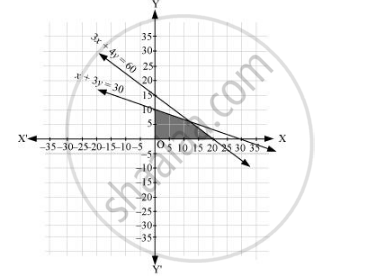
Solve the following system of inequalities graphically: 3x + 4y ≤ 60, x + 3y ≤ 30, x ≥ 0, y ≥ 0
Advertisements
उत्तर
3x + 4y ≤ 60 … (1)
x + 3y ≤ 30 … (2)
The graph of the lines, 3x + 4y = 60 and x + 3y = 30, are drawn in the figure below.
Inequality (1) represents the region below the line, 3x + 4y = 60 (including the line 3x + 4y = 60), and inequality (2) represents the region below the line, x + 3y = 30 (including the line x + 3y = 30).
Since x ≥ 0 and y ≥ 0, every point in the common shaded region in the first quadrant including the points on the respective line and the axes represents the solution of the given system of linear inequalities.
संबंधित प्रश्न
Solve the following system of inequalities graphically: x ≥ 3, y ≥ 2
Solve the following system of inequalities graphically: 2x + y≥ 6, 3x + 4y ≤ 12
Solve the following system of inequalities graphically: 2x – y > 1, x – 2y < –1
Solve the following system of inequalities graphically: 2x + y≥ 8, x + 2y ≥ 10
Solve the following system of inequalities graphically: x + y ≤ 9, y > x, x ≥ 0
Solve the following system of inequalities graphically: 5x + 4y ≤ 20, x ≥ 1, y ≥ 2
Solve the following system of inequalities graphically: x – 2y ≤ 3, 3x + 4y ≥ 12, x ≥ 0, y ≥ 1
Solve the following system of inequalities graphically: 4x + 3y ≤ 60, y ≥ 2x, x ≥ 3, x, y ≥ 0
Solve the following system of inequalities graphically: 3x + 2y ≤ 150, x + 4y ≤ 80, x ≤ 15, y ≥ 0, x ≥ 0
Solve the following system of inequalities graphically: x + 2y ≤ 10, x + y ≥ 1, x – y ≤ 0, x ≥ 0, y ≥ 0
Find all pairs of consecutive odd natural number, both of which are larger than 10, such that their sum is less than 40.
The marks scored by Rohit in two tests were 65 and 70. Find the minimum marks he should score in the third test to have an average of at least 65 marks.
A solution is to be kept between 86° and 95°F. What is the range of temperature in degree Celsius, if the Celsius (C)/ Fahrenheit (F) conversion formula is given by\[F = \frac{9}{5}C + 32\]
To receive grade 'A' in a course, one must obtain an average of 90 marks or more in five papers each of 100 marks. If Shikha scored 87, 95, 92 and 94 marks in first four paper, find the minimum marks that she must score in the last paper to get grade 'A' in the course.
A company manufactures cassettes and its cost and revenue functions for a week are \[C = 300 + \frac{3}{2}x \text{ and } R = 2x\] respectively, where x is the number of cassettes produced and sold in a week. How many cassettes must be sold for the company to realize a profit?
The longest side of a triangle is three times the shortest side and third side is 2 cm shorter than the longest side if the perimeter of the triangles at least 61 cm, find the minimum length of the shortest-side.
The water acidity in a pool is considered normal when the average pH reading of three daily measurements is between 7.2 and 7.8. If the first two pH reading are 7.48 and 7.85, find the range of pH value for the third reading that will result in the acidity level being normal.
Write the set of values of x satisfying the inequation (x2 − 2x + 1) (x − 4) < 0.
Write the solution set of the equation |2 − x| = x − 2.
Write the set of values of x satisfying |x − 1| ≤ 3 and |x − 1| ≥ 1.
Write the number of integral solutions of \[\frac{x + 2}{x^2 + 1} > \frac{1}{2}\]
Write the set of values of x satisfying the inequations 5x + 2 < 3x + 8 and \[\frac{x + 2}{x - 1} < 4\]
Write the solution of set of\[\left| x + \frac{1}{x} \right| > 2\]
Write the solution set of the inequation |x − 1| ≥ |x − 3|.
Solve each of the following system of equations in R.
\[5x - 7 < 3\left( x + 3 \right), 1 - \frac{3x}{2} \geq x - 4\]
Find the graphical solution of the following system of linear inequations:
x – y ≤ 0, 2x – y ≥ − 2
Find the graphical solution of the following system of linear inequations:
2x + 3y ≥ 12, – x + y ≤ 3, x ≤ 4, y ≥ 3
Find the graphical solution of the following system of linear inequations:
`"x"/60 + "y"/90 ≤ 1`, `"x"/120 + "y"/75 ≤ 1`, y ≥ 0, x ≥ 0
Solve the following system of inequalities graphically.
2x – y ≥ 1, x – 2y ≤ – 1
Solve the following system of inequalities `(2x + 1)/(7x - 1) > 5, (x + 7)/(x - 8) > 2`
Find the linear inequalities for which the shaded region in the given figure is the solution set.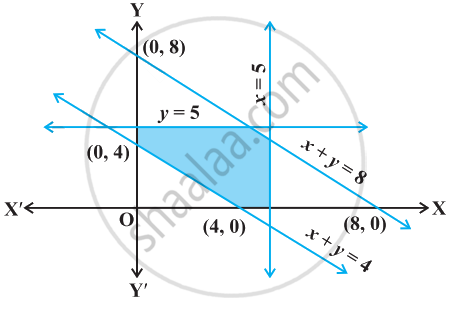
Show that the following system of linear inequalities has no solution x + 2y ≤ 3, 3x + 4y ≥ 12, x ≥ 0, y ≥ 1
Solve the following system of linear inequalities:
3x + 2y ≥ 24, 3x + y ≤ 15, x ≥ 4
Show that the solution set of the following system of linear inequalities is an unbounded region 2x + y ≥ 8, x + 2y ≥ 10, x ≥ 0, y ≥ 0.
Solution set of x ≥ 0 and y ≤ 0 is