Advertisements
Advertisements
प्रश्न
Sketch and label a diagram of the digestive system and describe it in your own words.
Advertisements
उत्तर

Digestive system
The major constituent organs of the human digestive system are the buccal cavity, oesophagus, stomach, small intestine, large intestine, rectum, and anus.
- Buccal cavity: It includes the teeth, saliva and tongue. The teeth break down the food. Digestion of food begins in the mouth. The tongue helps in the chewing and swallowing of food.
- Oesophagus: The food passes from the mouth, down the oesophagus, into the stomach as a result of the movement of the walls of the oesophagus.
- Stomach: It mixes the food received from the oesophagus with digestive juices.
- Small intestine: The food from the stomach moves into the small intestine, which receives intestinal juices from two.
- Gallbladder: Stores bile and releases it into the small intestine when needed.
- Pancreas: Produces enzymes that help digest proteins, fats, and carbs.
- Glands: the liver and pancreas. These juices help in the further digestion of food.
- Large intestine: Water is absorbed in the large intestine.
- Rectum and anus: Undigested food particles are thrown out with the help of the rectum and anus.
संबंधित प्रश्न
Carbohydrates are bodybuilding nutrients.
What is the function of enzymes in the human digestive system?
Where does digestion of fat take place in our body?
________ is the largest gland in the body.
Give two reasons to explain why the absorption of digested food occurs mainly in the small intestine.
Fill in the blank.
The teeth called ______ are a total of four in number on the sides of incisors
Define with examples: Heterotrophs
Correct the spellings: Disegion
The question has four options. Choose the correct answer:
The ileum is characterized by
Which systems work together to provide the body with energy?
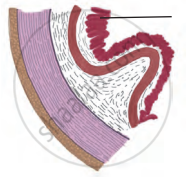
Observe the diagram. This is the histological structure of the stomach. Identify and comment on the significance of the layer marked by an arrow.
Why it is important to wear helmet while riding a bike?
Circle the odd one.
The common bile duct and pancreatic form ______.
The process of digestion is completed by:
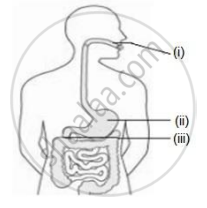
Identify the option that indicates the correct enzyme that is secreted in location A, B and C.
What are the compounds present in the food?
Given below from (i) to (iv) are some food items.
- Boiled and mashed potato
- Glucose solution
- A slice of bread
- Mustard oil
Which of the above will give a blue-black colour when tested with iodine?
Name the parts of the alimentary canal where water gets absorbed from undigested food.
Statement I - The muscularis of intestine can be differentiated into longitudinal and oblique muscles only.
Statement II - The muscularis of stomach is made up of outer- longitudinal, middle oblique and inner circular muscles.
In light of above statements, choose the most appropriate answer from the option given below.
