Advertisements
Advertisements
प्रश्न
Saturated hydrocarbon : Single bond : : Unsaturated hydrocarbon : _______
Advertisements
उत्तर
Saturated hydrocarbon : Single bond : : Unsaturated hydrocarbon : Double and/or triple bond
APPEARS IN
संबंधित प्रश्न
Write the name and formula of the 2nd member of homologous series having general formula CnH2n.
Ethene and ethyne are examples of ______ hydrocarbons.
Give the molecular formula of one homologue of the following:
C3H6
Write the names and formulae for the first three members of the homologous series of chloroalkanes.
The molecular formula of a homologue of butane is ______.
An organic compound having the molecular formula C3H6O can exist in the form of two isomers A and B having different functional groups. The isomer A is a liquid which is used as a solvent for nail polish. The isomer B is also a liquid. An aqueous solution of one of the lower homologues of B is used for preserving biological specimens in the laboratory
(a) What is compound A?
(b) Write the electron-dot structure of A.
(c) What is compound B?
(d) Write the electron-dot structure of B.
(e) Name the lower homologue of compound B which is used in preserving biological specimens.
Succeeding members of a homologous series differ by ______.
Give the dot diagram of the first member of the alcohol.
Give the names and the structural formula of the first three members of the homologous series of alkanes.
What is homologous series ?
What is the difference in the molecular formula of any two adjacent homologues in terms of molecular mass?
 .
.
Give the names of the first four members of the homologous series of
alkynes.
Write the name and formula of the fourth member of the following homologous series:
Alkyne
The phenomenon in which compounds having different structural formulae have the same molecular formula is called _______.
Complete the following table for homologous series of alcohols.
| Name | Molecular formula | Condensed structural formula | Number of carbon atom | Number of -CH2- units | Boiling point °C |
| Methanol | CH4O | CH3-OH | 1 | 1 | 63 |
| Ethanol | C2H6O | CH3–CH2-OH | 2 | 2 | 78 |
| Propanol | C3H8O | CH3–CH2–CH2-OH | ______ | ______ | 97 |
| Butanol | C4H10O | CH3–CH2–CH2–CH2–OH | ______ | ______ | 118 |
Observe the structural formula and answer the following questions.
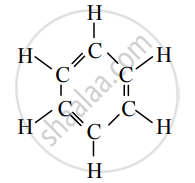
- Write the name of the given hydrocarbon.
- The given hydrocarbon is included in which type of hydrocarbon?
- What is the kind of compounds with the above characteristic structure called?
C3H8 belongs to the homologous series of ______.
A carbon compound ‘A’ having melting point 156K and boiling point 351K, with molecular formula C2H6O is soluble in water in all proportions.
- Identify ‘A’ and draw its electron dot structure.
- Give the molecular formulae of any two homologues of ‘A’.
