Advertisements
Advertisements
प्रश्न
Read the following sentences.
(a) If she knows we have a cat, Paati will leave the house.
(b) She won’t be so upset if she knows about the poor beggar with sores on his feet.
(c) If the chappals do fit, will you really not mind? Notice that each sentence consists of two parts. The first part begins with ‘if’. It is known as if-clause.
Rewrite each of the following pairs of sentences as a single sentence. Use ‘if’ at the beginning of the sentence
Don’t tease the dog. It’ll bite you
Advertisements
उत्तर
If you tease the dog, it’ll bite you.
संबंधित प्रश्न
Thinking about the Text
On the following map mark out the route, which the author thought of but did not take, to Delhi.

Answer these question in one or two words or in short phrase.
The writer says, “All this I wash down with Coca Cola.” What does ‘all this’ refer to?
Thinking about the Poem
What did Saint Peter ask the old lady for? What was the lady’s reaction?
Answer following question in short.
How did kangaroos react to duck’s request?
The cat and the author are very fond of each other. How has this been shown in the story? Where was the cat after the fire? Who brings it back and how?
Now read the following account
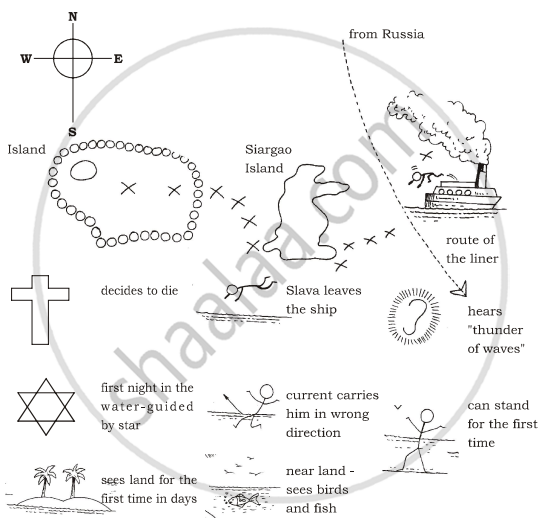
Given below is a map of the area in which Slava Kurilov faced his ordeal. You will also see the major events in the story, in mixed order, each accompanied by a symbol. After you have read ‘Ordeal in the Ocean’, draw the appropriate symbol against each x mark. (One is already drawn for you.) Draw the symbols or number the symbols, and transfer them to the map.)
Did you notice the phrases used by debaters to emphasise/negate certain points? Given below are certain expressions that might be used by debaters.
1. I'd like to raise a/the question/ argue ___
2. In my opinion ___
3. Nothing could be more illogical than ____
4. I feel very strongly that ___
5. I would like to draw attention to ___
6. I fail to understand ____
7. I thinkyou are being unreasonable in suggesting ___
8. I submit that ____
9. My first/ next/ final argument against/ in favour of ____
10. I support the motion that_____
11. My knowledgeable opponent has submitted that ____
12. May l ask ___
13. I strongly oppose/ support the view that ___
14. On the contrary ___
15. It is unrealistic to say that ____
16. I disagree ____
17. I firmly reject ____
18. I wholeheartedly oppose/ support____
Whom does Portia ultimately marry? Who were the two other suitors who took the test? Why, in your opinion, is the person whom she marries worthy of her?
Read the extract given below and answer the questions that follow:
Bassanio: To You, Antonio,
I owe the most, in money and in love;
And from your love, I have a warranty
To unburden all my plots and purposes
How to get clear of all the debts I owe.
Antonio: I pray you, good Bassanio, let me know it;
(i) Describe Antonio's mood at the beginning of this scene.
State any two reasons that Antonio's friends, who · were present, gave to explain his mood.
(ii) What promise did Antonio make to Bassanio immediately after this conversation?
(iii) What did Bassanio say to Antonio about 'a lady richly left' in Belmont?
(iv) Why was Antonio unable to lend Bassanio the ·money that he needed?
(v) What does the above extract reveal of the relationship between Antonio and Bassanio?
Mention' one way in which this relationship was put to the test later in the play.
Complete the following poem with words from the box below. Then recite the poem.
Soldiers live in barracks
And birds in ———————,
Much like a snake that rests
In a ———————. No horse is able
To sleep except in a ———————.
And a dog lives well,
Mind you, only in a ———————.
To say ‘hi’ to an ant, if you will,
You may have to climb an ———————.
| hole | kennel | nests | anthill | atable |
Why the early man was afraid of fire?
What assurance did the sunrays give to Saeeda?
What does mother Warn him?
How did Taro meet the demand of his father?
Talk to your partner and say whether the following statement is true or false.
No animal can survive without water.
Identify the ‘he’ in the first line.
Study the following phrases and their meanings. Use them appropriately to complete the sentences that follow.
If you want to go out, I will ………….. the children for you.
| Caliban: |
No noise, and enter |
In the above lines taken from Act IV Scene i of the play, The Tempest, what does Caliban refer to by the phrase “good mischief“?
In what ways does power corrupt in the play Macbeth? Discuss any one character who is corrupted by power in the play. Incorporate the following details and answer in 100-150 words.
- The character’s traits before coming to power
- The character’s degeneration after coming into power
