Advertisements
Advertisements
प्रश्न
Rahul wants to make an electric circuit. He has a bulb, two wires, a safety pin, and a piece of copper. He does not have any electric cell or battery. Suddenly he gets some idea. He uses lemon instead of a battery and makes a circuit. Will the bulb glow?
Advertisements
उत्तर
Yes, the bulb will glow:
- Take a lemon. Squeeze it without breaking its skin. The squeezing action releases the juice inside the lemon needed as the battery works.
- Use a nail to make one hole in one end of the lemon and push a copper wire into that hole.
- Then, push the nail into the other end.
- Connect a bulb with one of the terminals with the copper wire and the other terminals with the nail, as shown in the figure.
- Now the lemon generates a small amount of electricity and the bulb glows.

APPEARS IN
संबंधित प्रश्न
Draw a schematic diagram of a circuit consisting of a battery of three cells of 2 V each, a 5 Ω resistor, an 8 Ω resistor, and a 12 Ω resistor, and a plug key, all connected in series.
Draw circuit symbols for
an open switch
The accompanying figure shows some electrical appliances connected in a circuit in a house. Answer the following questions.

- By which method are the appliances connected?
- What must be the potential difference across individual appliances?
- Will the current passing through each appliance be the same? Justify your answer.
- Why are the domestic appliances connected in this way?
- If the T.V. stops working, will the other appliances also stop working? Explain your answer.
Answer the following question.
With the help of a suitable circuit diagram prove that the reciprocal of the equivalent resistance of a group of resistances joined in parallel is equal to the sum of the reciprocals of the individual resistances.
How much is the potential difference between live and neutral wires?
Tabulate the different components of an electric circuit and their respective symbols.
In which of the following circuits are the bulb connected in series?
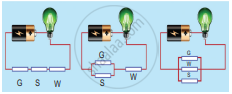
Study the three electric circuits below. Each of them has a glass rod (G), a steel rod (S), and a wooden rod (W).
In which of the electric circuits would the bulb not light up.
What are the types of electric circuits?
Paheli is running short of connecting wires. To complete an electric circuit, she may use a ______.
