Advertisements
Advertisements
प्रश्न
Plot the points P(1, 0), Q(4, 0) and S(1, 3). Find the coordinates of the point R such that PQRS is a square.
Advertisements
उत्तर
In point P(1, 0), y-coordinate is zero, so it lies on x-axis.
In point Q(4, 0), y-coordinate is zero so it lies on x-axis.
In point S(1, 3), both coordinates are positive, so it lies in I quadrant.
On plotting these points, we get the following graph.
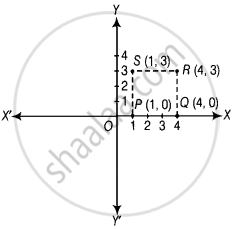
Now, take a point R on the graph such that PQRS is a square.
Then, all sides will be equal i.e., PQ = QR = RS = PS.
So, abscissa of R should be equal to abscissa of Q i.e., 4 and ordinate of R should be equal to ordinate of S i.e., 3.
Hence, the coordinates of R are (4, 3).
APPEARS IN
संबंधित प्रश्न
Plot the points (x, y) given in the following table on the plane, choosing suitable units of distance on the axes.
| x | -2 | -1 | 0 | 1 | 3 |
| y | 8 | 7 | -1.25 | 3 | -1 |
Plot the following point on the graph paper:
(−5, −7)
Plot the following point on the graph paper:
(−3, 2)
Plot the following point on the graph paper:
(7, 0)
Some points are shown in the following figure. With the help of it answer the following questions:

- Write the co-ordinates of the points Q and R.
- Write the co-ordinates of the points T and M.
- Which point lies in the third quadrant?
- Which are the points whose x and y co-ordinates are equal?
Plot the following points in the coordinate plane. Join them in order. What type of geometrical shape is formed?
(−3, 3) (2, 3) (−6, −1) (5, −1)
Plot the following point in a graph sheet.
G(7, −4)
If P(–1, 1), Q(3, –4), R(1, –1), S(–2, –3) and T(–4, 4) are plotted on the graph paper, then the point(s) in the fourth quadrant are ______.
If P(5, 1), Q(8, 0), R(0, 4), S(0, 5) and O(0, 0) are plotted on the graph paper, then the point(s) on the x-axis are ______.
In the following figure, the point identified by the coordinates (–5, 3) is ______.