Advertisements
Advertisements
प्रश्न
On a graph paper plot the points A (3, 0), B(3, 3), C(0, 3). Join A, B and B, C. What is the figure formed?
Advertisements
उत्तर
The given points are A(3, 0), B(3, 3) and C(0, 3). These points can be plotted on the co-ordinate plane as follows:

The x co-ordinate of point is its distance from the Y-axis and y co-ordinate of point is its distance from the X-axis.
Here, OA = AB = BC = OC = 3 units
Therefore, the figure formed is a square.
APPEARS IN
संबंधित प्रश्न
In which quadrant or on which axis do each of the points (– 2, 4), (3, – 1), (– 1, 0), (1, 2) and (– 3, – 5) lie? Verify your answer by locating them on the Cartesian plane.
Plot the points (x, y) given in the following table on the plane, choosing suitable units of distance on the axes.
| x | -2 | -1 | 0 | 1 | 3 |
| y | 8 | 7 | -1.25 | 3 | -1 |
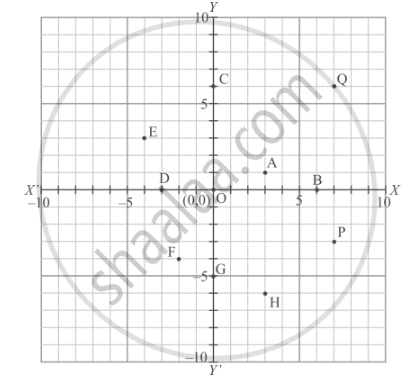
Write the coordinates of each of the following points marked in the graph paper:
Plot the following point on the graph paper:
(0, 7)
Some points are shown in the following figure. With the help of it answer the following questions:

- Write the co-ordinates of the points Q and R.
- Write the co-ordinates of the points T and M.
- Which point lies in the third quadrant?
- Which are the points whose x and y co-ordinates are equal?
Write down the abscissa and ordinate of the following.
P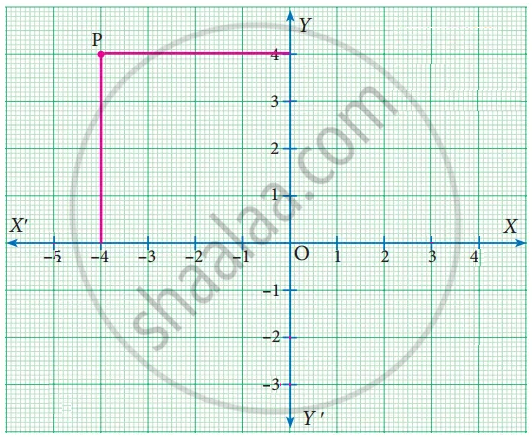
Plot the following points in the coordinate plane. Join them in order. What type of geometrical shape is formed?
(0, 0) (−4, 0) (−4, −4) (0, −4)
Plot the following point in a graph sheet.
B(−7, −3)
Plot the following point in a graph sheet.
G(7, −4)
Find the quadrants without plotting the point on a graph sheet
(−7, 2)
In the following figure, coordinates of P are ______.
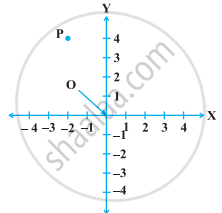
Plot the points (x, y) given by the following table:
| x | 2 | 4 | – 3 | – 2 | 3 | 0 |
| y | 4 | 2 | 0 | 5 | – 3 | 0 |
Plot the following points and check whether they are collinear or not:
(1, 1), (2, – 3), (– 1, – 2)
Plot the points (x, y) given by the following table. Use scale 1 cm = 0.25 units
| x | 1.25 | 0.25 | 1.5 | – 1.75 |
| y | – 0.5 | 1 | 1.5 | – 0.25 |
From the figure, answer the following:
Write the points whose abscissa is – 5.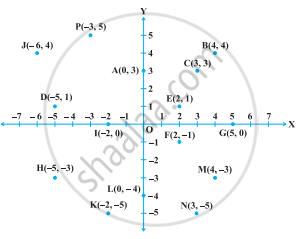
Plot the points A(1, – 1) and B(4, 5). Extend this line segment and write the coordinates of a point on this line which lies outside the line segment AB.
