Advertisements
Advertisements
प्रश्न
One day in the morning, Ramesh filled up 1/3 bucket of hot water from geyser, to take bath. Remaining 2/3 was to be filled by cold water (at room temperature) to bring mixture to a comfortable temperature. Suddenly Ramesh had to attend to something which would take some times, say 5-10 minutes before he could take bath. Now he had two options: (i) fill the remaining bucket completely by cold water and then attend to the work, (ii) first attend to the work and fill the remaining bucket just before taking bath. Which option do you think would have kept water warmer? Explain.
Advertisements
उत्तर
Using the concept of Newton’s law of cooling, we can say that rate of cooling is directly proportional to the difference in the temperature of the body and surroundings.
According to the first option, the water should be warmer, as the difference between the temperature of the surroundings and the water is small, therefore, less heat is lost.
According to the second option, the heat lost is more, as the difference between the surroundings and water is large.
APPEARS IN
संबंधित प्रश्न
On a hot summer day we want to cool our room by opening the refrigerator door and closing all the windows and doors. Will the process work?
On a cold winter night you are asked to sit on a chair. Would you like to choose a metal chair or a wooden chair? Both are kept in the same lawn and are at the same temperature.
An ordinary electric fan does not cool the air, still it gives comfort in summer. Explain
The temperature of the atmosphere at a high altitude is around 500°C. Yet an animal there would freeze to death and not boil. Explain.
Newton's law of cooling is a special case of
Answer the following question.
State Newton’s law of cooling and explain how it can be experimentally verified.
Solve the following problem.
A metal sphere cools at the rate of 0.05 ºC/s when its temperature is 70 ºC and at the rate of 0.025 ºC/s when its temperature is 50 ºC. Determine the temperature of the surroundings and find the rate of cooling when the temperature of the metal sphere is 40 ºC.
A bucket full of hot water cools from 85 °C to 80 °C in time T1, from 80 °C to 75 °C in time T2 and from 75 °C to 70 °C in time T3, then ______.
A metal sphere cools from 66° C to 57° C in 10 minutes and to 44° C in the next 10 minutes. The ratio of fall of temperature of first 10 minutes to next ten minutes is ____________.
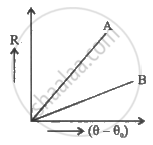
Two circular discs A and B with equal radii are blackened. They are heated to the same temperature and are cooled under identical conditions. What inference do you draw from their cooling curves?
A cup of coffee cools from 90°C to 80°C in t minutes, when the room temperature is 20°C. The time taken by a similar cup of coffee to cool from 80°C to 60°C at a room temperature same at 20°C is ______.
A glass full of hot milk is poured on the table. It begins to cool gradually. Which of the following is correct?
- The rate of cooling is constant till milk attains the temperature of the surrounding.
- The temperature of milk falls off exponentially with time.
- While cooling, there is a flow of heat from milk to the surrounding as well as from surrounding to the milk but the net flow of heat is from milk to the surounding and that is why it cools.
- All three phenomenon, conduction, convection and radiation are responsible for the loss of heat from milk to the surroundings.
Is the bulb of a thermometer made of diathermic or adiabatic wall?
In 5 minutes, a body cools from 75°C to 65°C at a room temperature of 25°C. The temperature of the body at the end of the next 5 minutes is ______°C.
A metal sphere cools in a room at 30°C. At T = 70°C, dT/dt = −1.6°C/min. Find C.
A body cools from 60°C to 40°C in 6 minutes. After next 6 minutes its temperature will be (Temperature of the surroundings is 10°C) ______.
A body is cooling from 80°C to 60°C in a room at 30°C. Compared to the time taken to cool from 60°C to 40°C, the time taken to cool from 80°C to 60°C will be ______.
