Advertisements
Advertisements
प्रश्न
On the basis of the questionnaire, hold a conversation with your partner - one could be a radio jockey and the other could be the pilot.
Advertisements
उत्तर
RJ : “Congratulations! By God’s grace you survived to tell your story.” Pilot: “Yes! I am lucky.”
RJ : “Can you tell what happened once you reached the Bermuda Triangle?”
Pilot: “When I was approaching the area everything seemed to be normal. The weather was pleasant and the sky was clear. Then suddenly the blip on my radar started behaving abnormally. I was unable to contact the control tower.”
RJ : “Can you remember what happened after that?”’
Pilot: “Yes! After I regained consciousness I started hearing cries of ‘Quit India’. It seemed that I was the spectator of a march by Gandhiji during 1940s. Everything looked black and white. I thought that I had died and reached heaven.”
RJ : “How did you survive?”
Pilot: “Suddenly my plane went into a tailspin and crash-landed at a small island. Luckily my radio was working by then and it enabled me to contact the control tower.”
APPEARS IN
संबंधित प्रश्न
Answer the following questions briefly:
(a) In 1953, Hooper was a favoured young man. Explain.
(b) They said that they would create a desk job for Hooper at headquarters.
- Who are ‘they’?
- Why did they decide to do this?
(c) Duke was an extraordinary dog. What special qualities did he exhibit to justify this? Discuss.
(d) What problems did Chuck present when he returned to the company headquarters?
(e) Why do you think Charles Hooper’s appointment as Assistant National Sales Manager is considered to be a tribute to Duke?
Answer the following question briefly:
What does the dark, sun-dried appearance of the Sergeant suggest about him?
Answer the following question briefly:
What were the Professor’s ambitions in the army?
Answer the following question:
Who was Jerry Fisher? What did he say to try and convince Bill to change his mind?
The sequence of events has been jumbled up. Rearrange them and complete the given flowchart.
(1) Major Percy and Bill come to the house.
(2) Harold comes to know that his father is a boxer.
(3) Bill tells his wife that he is doing it for Harold.
(4) Jerry Fisher tries to convince Bill to reconsider.
(5) Mrs. Bramble is amazed to think that she has brought such a prodigy as Harold into the world.
(6) Harold wants to know what will happen to the money he had bet on Murphy losing.(7) Mrs. Bramble is informed that Bill had decided not to fight.
(8) Mrs. Bramble resumes work of darning the sock.
(9) Harold is alone with his mother in their home.

Answer the following questions:
The poem has many examples of alliteration. List any five examples.
Answer the following question briefly.
Do you think the punishment given to the convict was justified? Why/ Why not?
Why is the convict eager to reach Paris?
The news
(a) Narendra Singh – broke record – long jump – regional meet – Principal sent congratulations – also President Youth Federation
(b) Narendra Singh from St. Michael’s School has broken the regional long jump record. The principal of St. Michael’s has sent his congratulations. Best wishes have also come from the President of the Youth Federation.
_________________________________________
Exchange notes with your partner. Read out your partner’s information as a news broad¬cast. Use the present perfect tense to report I express actions completed in the recent past but whose effect still remains.
Use your imagination to make the news item sound exciting
The Indian Rhinoceros: Where are they? Do they have a future?
We are very materialistic and are often lured into buying and using clothes and articles made from animal skin and other organs.
Here's a shopping list ....... .

The list seems endless, doesn't it? Are these things not shameful enough to set us pondering deeply over the harm that we are inflicting on nature's creations?
1. Why is the list 'most shameful'?
2. What is the name of the organisation that has been formed to protect and conserve wildlife?
3. Name at least ten other animals that are being exploited by man for commercial purposes. Surf the net to get your information and complete the following table
| Animal | Part of the body used | Product |
| 1. | ||
| 2. | ||
| 3. | ||
| 4. | ||
| 5. | ||
| 6. | ||
| 7. | ||
| 8. | ||
| 9. | ||
| 10. |
Look at the notes given below and complete the paragraph that follows by choosing the correct options from the choices given below. Write the correct options in your answer sheet against the correct blank numbers.
Kalakshetra - cultural academy - preserves - Indian art - founded in 1936 - internationally recognized Indian Parliament Act - institution of national Importance.
Kalakshetra is a cultural academy dedicated to (a) especially Bharathanatyam. The academy (b) Arundale and under her guidance the institution achieved (c) for its unique style and
perfection. In 1993 an (d) recognized the Kalakshetra foundation as an institution of national importance.
(a) (i) preserving Indian art
(ii) preservation in Indian art
(iii) preserves Indian art
(iv) preserve Indian art
(b) (i) is being founded in 1936 by
(ii) was founded in 1936 by
(iii) has been founded in 1936 by
(iv) founded in 1936 by
(c) (i) internationally recognised
(ii) internationally recognition
(iii) international recognition
(iv) international recognised
(d) (i) an Act of the Indian Parliament
(ii) an Act by Indian Parliament
(iii) an Act in Indian Parliament
(iv) the Act by Indian Parliament
Complete the following passage by choosing the correct option. The first one has been done as an example:
Martin Cooper, (a) _______ a Motorola researcher and executive, is widely (b) _______ to be the inventor (c)_______ the first mobile phone in 1973. There are (d) _______ categories of mobile phones (e)_______ from basic phones and feature phones (f)______ as music phones, camera phones to smart phones. The (g)_________commonly used data application on mobile phones (h)______ text messaging. Mobile phones generally (i)_______power from batteries which (j)_______ be recharged. The use of cellphones (k)_________ while driving as a safety measure.
| (a) (i) an (ii) the (iii) a (iv) X |
(b) (i) consider (ii) considered (iii) considering (iv) have considered |
(c) (i) for (ii) of (iii) as (iv) off |
(d) (i) many (ii) few (iii) much (iv) more |
| (e) (i) are ranging (ii) ranging (iii) range (iv) ranges |
(f) (i) some (ii) like (iii) such (iv) similar |
(g) (i) much (ii) more (iii) most (iv) many |
(h) (i) is (ii) are (iii) has been (iv) being |
| (i) (i) obtain (ii) is obtaining (iii) obtaining (iv) obtained |
(j) (i) would (ii) can (iii) may (iv) should |
(k) (i) ban (ii) was banned (iii) banning (iv) is banned |
Is there enough variety of content?
Ganesh comes to visit Vikram and finds the house locked. He leaves a note. It is raining, the note gets wet and some words are washed off. Complete the note by filling in the missing words by choosing the correct option given below.
Dear Ram
I am so sorry to have missed you. I came to Udaipur on (a) _________ business trip and I have been here (b) _________ two weeks now. Your neighbours told me (c) _________ sad news that your father (d) _________ been hospitalized. I wish I (e) _________ see him but unfortunately I (f) _________ leaving for Madras today on (g) _________ 4 o’clock plane. Please send your father my best wishes. Anyway, I (h) _________ be in Udaipur again on 3rd and 4th June and I (i) _________ certainly find time to call on vou even though it (j) _________ some to be a hectic schedule.
Yours affectionately
Ganesh
| (a) (i) X (ii) the (iii) a (iv) an |
(b) (i) since (ii) from (iii) for (iv) in |
| (c) (i) the (ii) X (iii) an (iv) a |
(d) (i) is (ii) being (iii) has (iv) have |
| (e) (i) could (ii) have (iii) can (iv) having |
(f) (i) am (ii) been (iii) is (iv) being |
| (g) (i) a (ii) by (iii) the (iv) an |
(h) (i) am (ii) will (iii) are (iv) being |
| (i) (i) shall (ii) will (iii) ought to (iv) must |
(j) (i) would (ii) will (iii) shall (iv) is |
Fill in the table to identify the subject, verb and object in the sentences listed above. You may include the object/agent where necessary.
| Subject | Verb | Object |
| Kareena’s hometown |
had not been invaded |
(by) the marvels of technology. |
| Industries | ___________ Was not polluted |
__________ __________ |
| Stories | __________ | __________ |
Did you know?
A passive construction does two things.
(i) it brings the object to the position of the subject.
(ii) it introduces the verb be and the past participle form of the verb. (-ed/ -en)
A passive construction is be used when
(a) the agent is unknown
e.g. Gold jewellery worth one crore was found missing.
(b) the agent is too obvious
e.g. The speeding car was stopped at the signal for violating the traffic rules.
(c) the process is more important than the doer.
e.g. Vanilla flavour is added to the milkshake.
(d) the speaker wants to hide the source for confidentiality.
e.g. I was informed that the staff accept gifts from the customers.
The Passive in Tentative Statements
The passive is often used in tentative statements where the writer tries to be as neutral as possible.
| considered | to | be… | ||
| It | is | said | ||
| known | to | have been… | ||
| They | are | acknowledged believed regarded as… |
8.1
Look at the box below. Write tentative statements following the pattern in the table above.
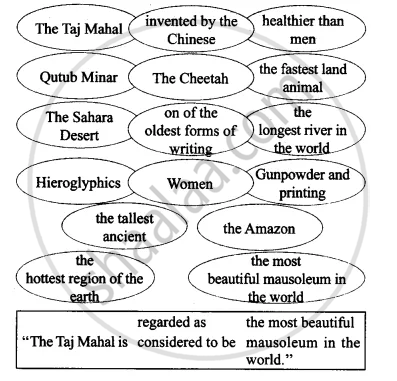
Fill in the empty bubbles in Column C with reports of what was said in Column A, as in the box given above.

In pairs, choose one topic from the table in Question 3. Imagine that you and your parents are expressing your views on the topic. Use your notes from the table and write the dialogue that would take place. Make it funny! Share your dialogue with the rest of the class.
Sports Day at school is always great fun. Along with the excitement of the events, there is the added desire to know if your House has won the Sports Championship Cup!
Teacher/ student can read out the Sports Day commentary and fill in the House positions for each event - 1st, 2nd and 3rd. Then calculate the points to find out which House has won the Sports Championship Cup.
GOVERNMENT SENIOR SECONDARY SCHOOL, DANAPUR
ANNUAL ATHLETIC MEET
SCORECARD
| House | NEHRU | RAMAN | TAGORE | SHIVAJI | ||||
| Events | Position | Points | Position | Points | Position | Points | Position | Points |
| (Previous tally) | ||||||||
| March Past | ||||||||
| 800m (Boys) | ||||||||
| 1OOm (Girls) | ||||||||
| High jump (Boys) | ||||||||
| Javelin (Girls) | ||||||||
| House | NEHRU | RAMAN | TAGORE | SHIVAJI | ||||
| Events | Position | Points | Position | Points | Position | Points | Position | Points |
| Shot put (Boys) | ||||||||
| 400 relay (Girls) | ||||||||
| TOTAL | ||||||||
| RESULT | HOUSE |
| Champions | |
| 2nd | |
| 3rd | |
| 4th |
| SCORING (POINTS) | |||
| Event | 1st | 2nd | 3rd |
| March Past | 10 | x | x |
| Track and field | 10 | 5 | 3 |
| Relay | 15 | 10 | 5 |
Group the prepositions in the box below to indicate their use as prepositions of place (P), movement (M) or time (T). There may be more than one category for each.
| between ________ along ________ since ________ up ________ among ________ in front of ________ after ________ |
past ________ on ________ behind ________ round ________ for ________ across ________ through ________ |
before ________ until ________ beside ________ out of ________ at ________ under ________ during ________ |
Common Combinations using Prepositions
Link the words from the different columns to produce meaningful sentences. One has been completed as an example. If you wish, write out the correct sentences in your notebook.

