Advertisements
Advertisements
प्रश्न
Obtain an expression for de-Broglie wavelength of wave associated with material particles. The photoelectric work function for metal is 4.2 eV. Find the threshold wavelength.
Advertisements
उत्तर
De-Broglie equated the energy equation of Plank (wave nature) and Einstein (particle nature) such that,
E = hv (Plank energy relation)
E = mc2 (Einsteins mass-energy relation)
Where,
E = energy associated with the particle
h = planks constant
v = frequency associated with the particle
m = moss of the particle
c = speed of light
After equating equations (1) and (2) we get:
hv = mc2
`"h" "c"/lambda = "mc"^2 ...(because "v" = "c"/lambda)`
`lambda = "hc"/"mc"^2 = "h"/"mc"`
If the particle is moving with velocity 'v' then equation (3) becomes,
`lambda = "h"/"mv"`
The wavelength of the particle if energy is in electron volt is,
`lambda = (12,400 Å)/"E"`
Where E should be in eV.
After substituting the value of E i.e. 4.2 eV in equation (4) we get:
`lambda = (12,400 Å)/4.2`
= 2952.38 Å
Hence, the threshold wavelength of the particle is 2952.38 Å.
APPEARS IN
संबंधित प्रश्न
An electron, a proton, an α-particle, and a hydrogen atom are moving with the same kinetic energy. The associated de Broglie wavelength will be longest for ______.
State the importance of Davisson and Germer experiment.
Explain what you understand by the de Broglie wavelength of an electron. Will an electron at rest have an associated de Broglie wavelength? Justify your answer.
Two particles have the same de Broglie wavelength and one is moving four times as fast as the other. If the slower particle is an α-particle, what are the possibilities for the other particle?
Find the ratio of the de Broglie wavelengths of an electron and a proton when both are moving with the (a) same speed, (b) the same kinetic energy, and (c) the same momentum. State which of the two will have a longer wavelength in each case.
According to De-Broglie, the waves are associated with ______
An electron is accelerated through a potential of 120 V. Find its de Broglie wavelength.
Explain De Broglie’s Hypothesis.
The de Broglie wavelength associated with photon is, ____________.
If the radius of the innermost Bohr orbit is 0.53 Å, the radius of the 4th orbit is ______
How much energy is imparted to an electron so that its de-Broglie wavelength reduces from 10-10 m to 0.5 × 10⁻¹⁰ m? (E =energy of electron)
The wavelength '`lambda`' of a photon and de-Broglie wavelength of an electron have same value. The ratio of energy of a photon to kinetic energy of electron is (m = mass of electron, c = velocity of light, h = Planck's constant) ____________.
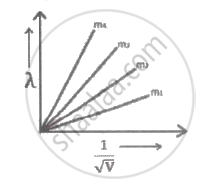
Graph shows the variation of de-Broglie wavelength `(lambda)` versus `1/sqrt"V"`, where 'V' is the accelerating potential for four particles carrying same charge but of masses m1 , m2, m3, m4. Which particle has a smaller mass?
If the potential difference used to accelerate electrons is doubled, by what factor does the de-Broglie wavelength associated with the electrons change?
A photon of wavelength 3315 Å falls on a photocathode and an electron of energy 3 x 10-19 J is ejected. The threshold wavelength of photon is [Planck's constant (h) = 6.63 x 10⁻³⁴ J.s, velocity of light (c) = 3 x 10⁸ m/s] ____________.
Explain de-Broglie wavelength.
The energy of an electron having de-Broglie wavelength `λ` is ______.
(h = Plank's constant, m = mass of electron)
A proton, an electron and an alpha particle have the same energies. Their de-Broglie wavelengths will be compared as ______.
A photon and an electron have an equal energy ‘E’. The ratio of wavelength ‘λp’ of photon to that of electron ‘λe’ is proportional to ______.
If the potential difference used to accelerate electrons is tripled, by what factor does the de-Broglie wavelength associated with electrons change?
