Advertisements
Advertisements
प्रश्न
Advertisements
उत्तर
APPEARS IN
संबंधित प्रश्न
Suppose you are in a dark room. Can you see objects in the room? Can you see objects outside the room? Explain.
The diagram in Figure shows a point object P in front of a plane mirror MM1.
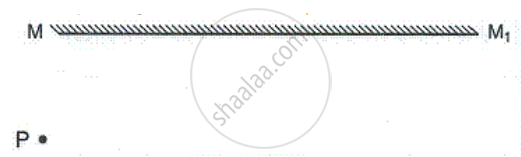
(a) Complete the diagram by taking two rays from the point P to show the formation of its image.
(b) In the diagram, mark the position of eye to see the image.
(c) Is the image formed real or virtual? Explain why?
What type of mirror is used to obtain a real image-of an object?
What do you understand by the Light?
An object is placed 2 cm from a plane mirror. If the object is moved by 1 cm towards the mirror, what will be the distance between the object and its new image?
An object 3 cm high produces a real image 4.5 cm high when placed at a distance of 20 cm from a concave mirror. Calculate:
- the position of image
- focal length of the concave mirror.
An object 1.5 cm high when placed in front of a concave. the mirror produces a virtual image 3 cm high. If the object is placed at a distance of 6 cm from the pole of the mirror, calculate:
- the position of the image
- the focal length of the mirror.
In the figure is shown a concave mirror. A is a point on the principal axis. If an object O is kept at A, image is formed on A itself. Copy the diagram. Draw the image in the diagram. Is the image real or virtual?

Measure the distance PA and write it in the diagram. What is the distance PA called?
Mark a point B on the principal axis, at which, if a point source of light is kept, the rays travel parallel to principal axis after reflection from M. What is point B called?
Find the odd one.
sun, candle, torch, pen
Why does a light ray incident on a rectangular glass slab immersed in any medium emerges parallel to itself? Explain using a diagram.
