Advertisements
Advertisements
प्रश्न
Name the phenomenon involved in tuning your radio set to a particular station and define it.
Advertisements
उत्तर
The phenomenon involved is resonance. It is a special case of forced vibrations. When the frequency of an externally applied periodic force on a body is equal to its natural frequency, the body rapidly begins to vibrate with an increased amplitude. This phenomenon is known as resonance.
संबंधित प्रश्न
How does the medium affect the amplitude of free/natural vibrations of a body?
What are forced vibrations?
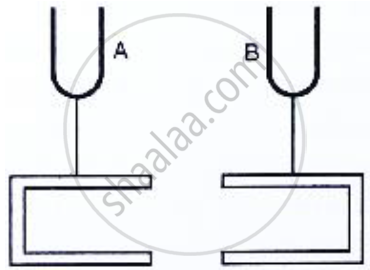
In following figure shows two tuning forks A and B of the same frequency mounted on two separate sound boxes with their open ends facing each other. The fork A is set into vibration.
- Describe your observation.
- State the principle illustrated by this experiment.
A tuning fork of frequency 256 Hz will resonate with another tuning fork of frequency:
Two pendulums C and D are suspended from a wire as shown in the figure give below. Pendulum C is made to oscullate by displaying it from its mean position. It is seen that D also starts oscillating.
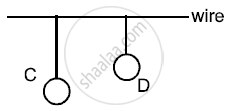
(i) Name the type of oscillation, C will execute.
(ii) Name the type of oscillation, D will execute.
(iii) If the length of D is made equal to C then what difference will you notice in the oscillations of D ?
(iv) What is the name of the phenomenon when the length of D is made equal to C ?
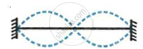
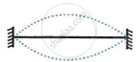
The diagram below shows three different modes of vibration P, Q and R of the same string of a given length.
 |
 |
 |
| P | Q | R |
- Which vibration will produce a louder sound and why?
- Which vibration will produce sound of maximum shrillness (or pitch) and why?
- What is the ratio of wavelength of vibrations P and R?
A bucket kept under a running tap is getting filled with water. A person sitting at a distance is able to get an idea when the bucket is about to be filled.
(i) What change takes place in the sound to give this idea?
(ii) What causes the change in the sound?
Explain a tuning fork (vibrating) is held close to ear. One hears a faint sound. The same vibrating tuning fork is placed on table, such that its handle is in contact with table, one hears a loud sound.
Describe a simple experiment to illustrate the phenomenon of resonance and explain it.
