Advertisements
Advertisements
प्रश्न
Name the defect of vision which can be corrected by a converging lens. Show clearly by a ray diagram how the lens corrects the defect.
Advertisements
उत्तर
Hypermetropia (long-sightedness) is a defect of vision that can be corrected by using converging lenses. The following ray diagram shows the correction of hypermetropia using a convex lens.
A person with hypermetropia cannot see nearby objects clearly but can see distant objects normally. Fig. (a) shows the near point of the hypermetropic eye, and fig. (b) shows the rays of light from a nearby object forming a blurred image, as the image is formed at a point behind the retina. To correct this defect, convex lenses are used in spectacles, because of which, as illustrated in fig. (c), the rays of light from the nearby object are converged to form a clear and sharp image of the object on the retina.

APPEARS IN
संबंधित प्रश्न
A student suffering from myopia is not able to see distinctly the objects placed beyond 5 m. List two possible reasons due to which this defect of vision may have arisen. With the help of ray diagrams, explain
(i) why the student is unable to see distinctly the objects placed beyond 5 m from his eyes.
(ii) the type of the corrective lens used to restore proper vision and how this defect is corrected by the use of this lens.
(b) If, in this case, the numerical value of the focal length of the corrective lens is 5 m, find the power of the lens as per the new Cartesian sign convention
Name one defect of vision (or eye) which cannot be corrected by any type of spectacle lenses.
Your friend can read a book perfectly well but cannot read the writing on blackboard unless she sits on the front row in class.
What type of lenses-converging or diverging-would an optician prescribe for her?
A student sitting in the last row of the class-room is not able to read clearly the writing on the blackboard.
Name the type of defect he is suffering from.
The defect of vision in which the eye-lens of a person gets progressively cloudy resulting in blurred vision is called:
(a) myopia
(b) presbyopia
(c) colourblindness
(d) cataract
The picture given here shows a person wearing 'half-moon' spectacles. What sort of eye-defect do do you think he has? Why are these particular spectacles useful to him?
To read a book held at a distance of 25 cm, will she need converging or diverging spectacle lenses?
What is Hypermetropia (far sightedness)?
Draw a ray diagram to show how Hypermetropia is defect can be corrected using a lens.
When do we consider a student sitting in the class to be myopic? List two causes of this defect. Explain using a ray diagram how this defect of eye can be corrected.
Given below is a diagram depicting a defect of the human eye? Study the same and answer the question that follow:
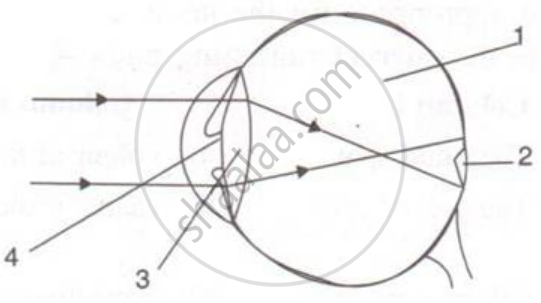
Give two possible reasons for this defect of the eye in human beings.
Given below is a diagram depicting a defect of the human eye? Study the same and answer the question that follow :
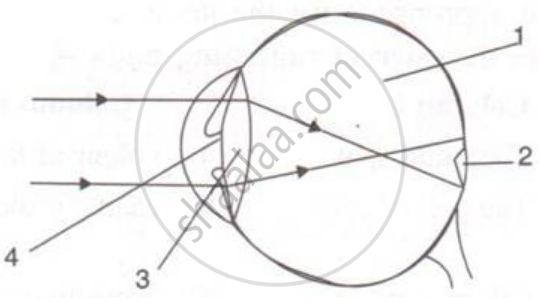
Name the type of lens used to correct this eye defect.
Have a look at the posture of this woman who is reading a book and answer the questions which follow:

What kind of looking glasses she needs?
In what two whys is a yellow spot different from the blind spot?
Name the common defects of the eye.
Differentiate between:
Myopia and Hypermetropia.
Explain the Term: Hypermetropia
Give Technical Term:
The path which responsible for protecting the eye from sweat.
Correlate the given sequence:
Hypermetropia : Convex lens : ______ : Concave lens
