Advertisements
Advertisements
प्रश्न
Advertisements
उत्तर
Four components of an electrical circuit
(i) Cell 

(ii) A load (bulb) 
(iii) Key 
(iv) Connecting wire 

APPEARS IN
संबंधित प्रश्न
The diagram below shows a circuit containing a lamp L, a voltmeter and an ammeter,. The voltmeter reading 3 V and the ammeter reading is 0.5 A.
What is the resistance of the lamp?
What is the power of the lamp?
At a given time, a house is supplied with 100 A at 220 V. How many 75 W, 220 V light bulb could be switched on in the house at the same time (if they are all connected in parallel)?
Two resistors A and B of resistance 4 Ω and 6 Ω respectively are connected in parallel. The combination is connected across a 6 volt battery of negligible resistance. Calculate: (i) the power supplied by the battery, (ii) the power dissipated in each resistor.
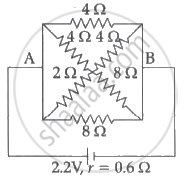
What is the current in the circuit shown (Fig. )

A coil of copper wire is connected to a galvanometer. What would happen if a bar magnet is:
(i) Pushed into the coil with its north pole entering first?
(ii) Held at rest inside the coil?
(iii) Pulled out again?
What is the order of current drawn by appliances connected to the ‘light circuit’ of a household?
Establish the relation that heat produced in a metallic conductor due to the flow of current is V2t/R joules, where V is the potential difference across the ends of the conductor, R its resistance and t is the time in second for which current flows.
Out of the three fuses with current ratings 5A, 10A, 15A, which one is to be connected in a geyser circuit marked 3 kW, 220V? Give reason for your answer.
A house is provided with 15 bulbs of 40W, 5 bulbs of 100W, 5 fans of 80 W, and one heater of 1.0 kW. Each day bulbs are used for 4h, fans for lOh, and heater for 2h. The voltage of mains is 220 V. Calculate:
(i) Maximum power of the circuit in the house,
(ii) maximum current capacity of the main fuse in the house,
(iii) the electrical energy consumed in a week,
(iv) cost of electricity consumed at 1.25 Rs. per kWh.