Advertisements
Advertisements
प्रश्न
List the names of three electrical gadgets used in your house. Write their power, voltage rating and approximate time for which each one is used in a day. Hence, find the electrical energy consumed by each in a day.
Advertisements
उत्तर
| Appliance | Power (in watts) |
Voltage (in volts) |
Time (hours) |
Electrical energy (E = p × t) |
| Fluorescent tube | 40 | 220 | 12 | 0.48 kWh |
| Television set | 120 | 220 | 4 | 0.48 kWh |
| Refrigerator | 150 | 220 | 24 | 3.6 kWh |
APPEARS IN
संबंधित प्रश्न
An electric lamp is labelled 12 V, 36 W. This indicates that it should be used with a 12 V supply. What other information does the label provide?
How much energy does a 100 W electric bulb transfer in 1 minute?
(a) 100 J
(b) 600 J
(c) 3600 J
(d) 6000 J
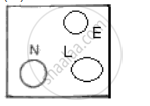
The diagram 31 shows a 3 terminal plug socket.
(i) What is the purpose of the terminal E?
(ii) To which part of the appliance is the terminal E connected?
(iii) To which wire L or N, is the fuse connected and why?
An electric bulb is rated 240V-60W and is working at 100% efficiency.
(i) Calculate the resistance of bulb.
(ii) (a) Draw the circuit diagram.
(b) What is the rate of conversion of energy in each bulb?
(c) Total power used by the bulbs.
An Electric bulb is marked 100 W, 230 V. What current does it take?
An Electric bulb is marked 100 W, 230 V. What how long would this lamp take to consume one unit of electricity?
The equation I2R seems to suggest that the rate of heating in a resistor is reduced if resistance decreases, whereas equation P = V2/R suggests just the opposite. How do you reconcile this problem?
