Advertisements
Advertisements
प्रश्न
Justify with reason, whether the following nuclear reactions are allowed or not.
\[\ce{^A_Z X -> ^A_{Z - 2}X + ^4_{2}He}\]
Advertisements
उत्तर
This reaction is not allowed because even though charge (atomic number) is conserved in it, the mass number [= A on the L H.S. and equal to (A + 4)] on the R.H.S. is not conserved.
संबंधित प्रश्न
What do you mean by Mass number.
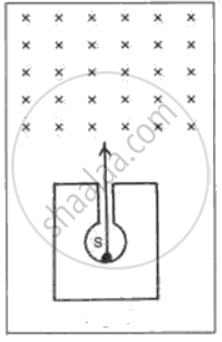
In following fig. shows a mixed source S of alpha and beta particles in a thick lead container. The particles pass through a magnetic field in a direction perpendicular to the plane of paper (inwards as shown by x). State and show in the diagram how the particles get affected.
Define the term radioactivity.
Name two radioactive substances.
A nucleus is \[\ce{^24_11 Na}\] β-radioactive.
Write the equation represent β-decay.
Why are materials of low work function preferred as thermionic cathode materials?
What is meant by Radioactivity?
Two radioactive materials A and B have decay constants 25λ and 16λ respectively. If initially they have the same number of nuclei, then the ratio of the number of nuclei of B to that of A will be "e" after a time `1/("a"lambda)` The value of a ______.
Assertion (A): The force of repulsion between atomic nucleus and α-particle varies with distance according to inverse square law.
Reason (R): Rutherford did α-particles scattering experiment.
