Advertisements
Advertisements
प्रश्न
What are free electrons?
Advertisements
उत्तर
Electrons revolving in the outermost orbit of an atom which are weakly held by the nucleus are called free electrons
APPEARS IN
संबंधित प्रश्न
State three factors on which the rate of emission of electrons from a metal surface depends
In a cathode ray tube state:
(i) the purpose of covering cathode by thorium and carbon.
(ii) the purpose of the fluorescent screen.
(iii) how is it possible to increase the rate of emission of electrons.
Radiations given out from a source when subjected to an electric field in a direction perpendicular to their path are shown below in the diagram. The arrows show the path of the radiation A, B and C. Answer the following questions in terms of A, B and C.
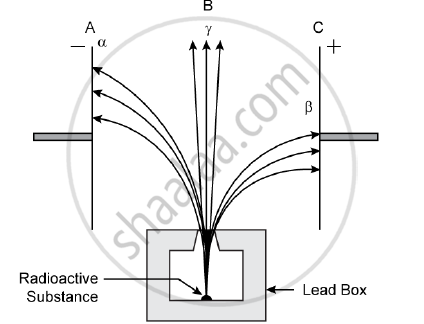
1) Name the radiation B which is unaffected by the electrostatic field.
2) Why does the radiation C deflect more than A?
3) Which among the three causes the least biological damage externally.
4) Name the radiation which is used in carbon dating.
When is said to be the nucleus unstable?
What are the uses of radioactive isotopes in following?
(a) Medical field,
(b) Agriculture,
(c) Industries?
A radioactive substance is oxidized. What changes would you expect to take place in the nature of radioactivity? Explain your answer.
A radioactive nucleus \[\ce{^A_ZX}\] undergoes spontaneous decay in the sequence \[\ce{^A_ZX -> _{Z-1 }B -> _{Z-3}C -> _{Z-2}D }\], where Z is the atomic number of element X. The possible decay particles in the sequence are ______.
The half-life of a radioactive nuclide is 100 hours. The fraction of original activity that will remain after 150 hours would be ______.
Which of the following correctly lists the three major types of radioactive decay found in nature?
