Advertisements
Advertisements
प्रश्न
It is said that the assumptions of kinetic theory are good for gases having low densities. Suppose a container is so evacuated that only one molecule is left in it. Which of the assumptions of kinetic theory will not be valid for such a situation? Can we assign a temperature to this gas?
Advertisements
उत्तर
Two postulates of kinetic theory will not be valid in this case. These are given below:
1. All gases are made up of molecules moving randomly in all directions
2. When a gas is left for a sufficient time, it comes to a steady state. The density and the distribution of molecules with different velocities are independent of position, direction and time.
APPEARS IN
संबंधित प्रश्न
If the molecules were not allowed to collide among themselves, would you expect more evaporation or less evaporation?
The mean square speed of the molecules of a gas at absolute temperature T is proportional to
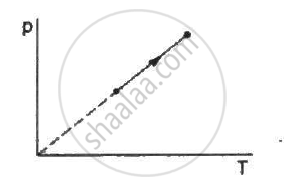
The process on an ideal gas, shown in figure, is
The temperature and the dew point in an open room are 20°C and 10°C. If the room temperature drops to 15°C, what will be the new dew point?
A glass contains some water at room temperature 20°C. Refrigerated water is added to it slowly. when the temperature of the glass reaches 10°C, small droplets condense on the outer surface. Calculate the relative humidity in the room. The boiling point of water at a pressure of 17.5 mm of mercury is 20°C and at 8.9 mm of mercury it is 10°C.
Answer in brief:
What will happen to the mean square speed of the molecules of a gas if the temperature of the gas increases?
Answer in brief:
Show that rms velocity of an oxygen molecule is `sqrt2` times that of a sulfur dioxide molecule at S.T.P.
If the density of oxygen is 1.44 kg/m3 at a pressure of 105 N/m2, find the root mean square velocity of oxygen molecules.
Two vessels A and B are filled with the same gas where the volume, temperature, and pressure in vessel A is twice the volume, temperature, and pressure in vessel B. Calculate the ratio of the number of molecules of the gas in vessel A to that in vessel B.
Under which condition laws of Boyle, Charles, and Gay-Lussac are valid?
Compare the rate of radiation of metal bodies at 727 °C and 227 °C.
What is the microscopic origin of temperature?
When photons of energy hv fall on a metal plate of work function 'W0', photoelectrons of maximum kinetic energy 'K' are ejected. If the frequency of the radiation is doubled, the maximum kinetic energy of the ejected photoelectrons will be ______.
A ring of mass m and radius r rotates about an axis passing through its centre and perpendicular to its plane with angular velocity `omega`. Its kinetic energy is ______.
A molecule consists of two atoms each of mass 'm' and separated by a distance 'd'. At room temperature the average rotational kinetic energy is 'E', then its angular frequency is ______.
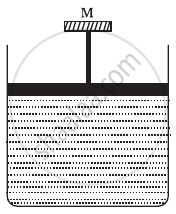
A cylinder containing an ideal gas is in vertical position and has a piston of mass M that is able to move up or down without friction (Figure). If the temperature is increased ______.
Two molecules of a gas have speeds of 9 × 10 6 ms−1 and 1 × 10⁶ ms−1, respectively. What is the root mean square speed of these molecules?
According to the kinetic theory of gases, at a given temperature, molecules of all gases have the same ______.
At what temperature will therms velocity of a gas be four times its value at STP?
