Advertisements
Advertisements
प्रश्न
In Δ ABC, B and Care fixed points. Find the locus of point A which moves such that the area of Δ ABC remains the same.
Advertisements
उत्तर
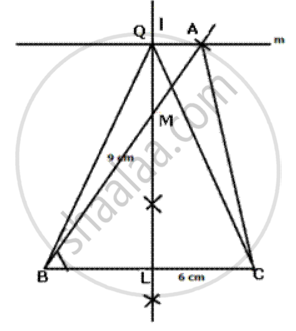
Steps of Construction:
(i) ABC is the required triangle.
(ii) Draw perpendicular bisector of BC which intersects BA in M, then any point on LM is equidistant from Band C.
(iii) Through A, draw a line m 11 BC.
(iv) The perpendicular bisector of BC and the parallel line m intersect each other at Q.
(v) Then triangle QBC is equal in area to triangle ABC. mis the locus of all points through which any triangle with base BC will be equal in area of triangle ABC.
APPEARS IN
संबंधित प्रश्न
Use ruler and compasses only for this question. Draw a circle of radius 4 cm and mark two chords AB and AC of the circle of lengths 6 cm and 5 cm respectively.
(i) Construct the locus of points, inside the circle, that are equidistant from A and C. prove your construction.
(ii) Construct the locus of points, inside the circle that are equidistant from AB and AC.
Plot the points A(2, 9), B(–1, 3) and C(6, 3) on graph paper. On the same graph paper draw the locus of point A so that the area of ΔABC remains the same as A moves.
In Δ PQR, s is a point on PR such that ∠ PQS = ∠ RQS . Prove thats is equidistant from PQ and QR.
Describe completely the locus of a point in the following case:
Centre of a circle of radius 2 cm and touching a fixed circle of radius 3 cm with centre O.
Construct a triangle ABC, such that AB= 6 cm, BC= 7.3 cm and CA= 5.2 cm. Locate a point which is equidistant from A, B and C.
Using a ruler and compass only:
(i) Construct a triangle ABC with BC = 6 cm, ∠ABC = 120° and AB = 3.5 cm.
(ii) In the above figure, draw a circle with BC as diameter. Find a point 'P' on the circumference of the circle which is equidistant from Ab and BC.
Measure ∠BCP.
Without using set squares or a protractor, construct:
- Triangle ABC, in which AB = 5.5 cm, BC = 3.2 cm and CA = 4.8 cm.
- Draw the locus of a point which moves so that it is always 2.5 cm from B.
- Draw the locus of a point which moves so that it is equidistant from the sides BC and CA.
- Mark the point of intersection of the loci with the letter P and measure PC.
How will you find a point equidistant from three given points A, B, C which are not in the same straight line?
Without using set squares or protractor.
(i) Construct a ΔABC, given BC = 4 cm, angle B = 75° and CA = 6 cm.
(ii) Find the point P such that PB = PC and P is equidistant from the side BC and BA. Measure AP.
Given ∠BAC (Fig), determine the locus of a point which lies in the interior of ∠BAC and equidistant from two lines AB and AC.
