Advertisements
Advertisements
प्रश्न
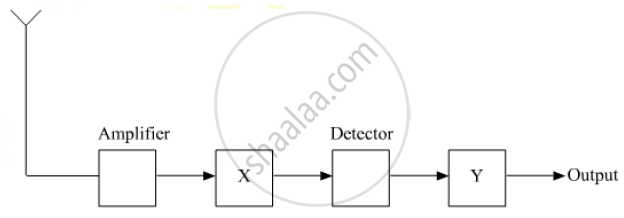
In the given block diagram of a receiver, identify the boxes labeled as X and Y and write their functions.
Advertisements
उत्तर
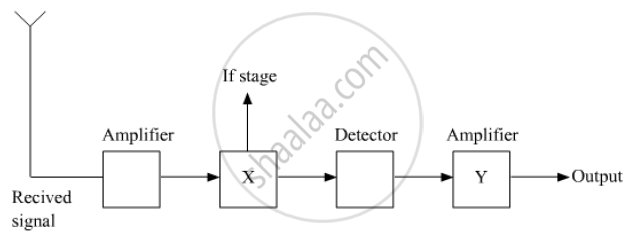
X → If stage → Intermediate frequency stage to change the carrier frequency to lower frequency.
Y → Amplifier → It amplifies the signal i.e. it increase the amplitude of the detected signal to compensate the attenuation of the signal. The detected signal may not be strong enough to use.
संबंधित प्रश्न
Draw a sketch of a sinusoidal carrier wave along with a modulating signal and show how these are superimposed to obtain the resultant amplitude modulated wave
A carrier wave of peak voltage 12 V is used to transmit a message signal. What should be the peak voltage of the modulating signal in order to have a modulation index of 75%?
What is the role of a bandpass filter?
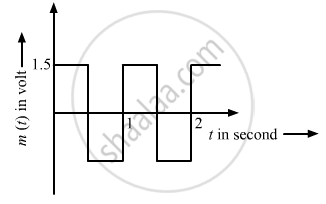
The carrier wave of a signal is given by C(t) = 3 sin (8πt) volt. The modulating signal is a square wave as shown. Find its modulation index.
Define the term modulation. Draw a block diagram of a simple modulator for obtaining AM signal ?
In the block diagram of a simple modulator for obtaining an AM signal, shown in the figure, identify the boxes A and B. Write their function.

Answer the following question.
Why a signal transmitted from a TV tower cannot be received beyond a certain distance? Write the expression for the optimum separation between the receiving and the transmitting antenna.
A 100 m long antenna is mounted on a 500 m tall building. The complex can become a transmission tower for waves with λ.
A male voice after modulation-transmission sounds like that of a female to the receiver. The problem is due to ______.
A carrier wave Vc(t) = 160 sin(2π × 106t) volts is made to vary between Vmax = 200 V and Vmin = 120 V by a message signal Vm(t) = Am sin(2π × 103t) volts. The peak voltage Am of the modulating signal is ______.
