Advertisements
Advertisements
प्रश्न
In a parallelogram PQRS (See the diagram) PM and PN are the heights corresponding to the sides QR and RS respectively. If the area of the parallelogram is 900 sq.cm and the length of PM and PN are 20 cm and 36 cm respectively, find the length of the sides QR and SR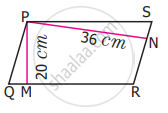
Advertisements
उत्तर
Considering QR as base of the parallelogram height h1 = 20 cm
Area of the parallelogram = 900 cm2
b1 × h1 = 900, b1 × 20 = 900
b1 = `900/20` = 45 cm
Again considering SR as base height = 36 cm, Area = 900 cm2
b2 × h2 = 900, b2 × 36 = 900
b2 = `900/36`
b2 = 25 cm
SR = 25 cm, QR = 45 cm, SR = 25 cm
APPEARS IN
संबंधित प्रश्न
Find the area of the following parallelogram:
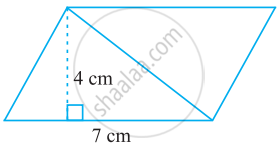
Find the area of the following parallelogram:
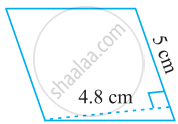
Find the area of the following parallelogram:
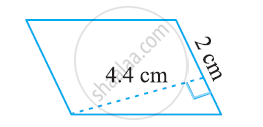
Area of a parallelogram is 83.2 sq cm. If its height is 6.4 cm, find the length of its base.
A parallelogram has sides of 15 cm and 12 cm; if the distance between the 15 cm sides is 6 cm; find the distance between 12 cm sides.
A parallelogram has sides of 20 cm and 30 cm. If the distance between its shorter sides is 15 cm; find the distance between the longer sides.
Find the missing values.
| Base | Height | Area |
| 18 cm | 5 cm |
The base of the parallelogram is 16 cm and the height is 7 cm less than its base. Find the area of the parallelogram
An agricultural field is in the form of a parallelogram, whose area is 68.75 sq.hm. The distance between the parallel sides is 6.25 cm. Find the length of the base
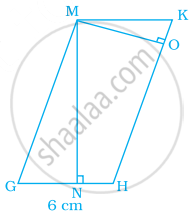
Altitudes MN and MO of parallelogram MGHK are 8 cm and 4 cm long respectively (see figure). One side GH is 6 cm long. Find the perimeter of MGHK.