Advertisements
Advertisements
प्रश्न
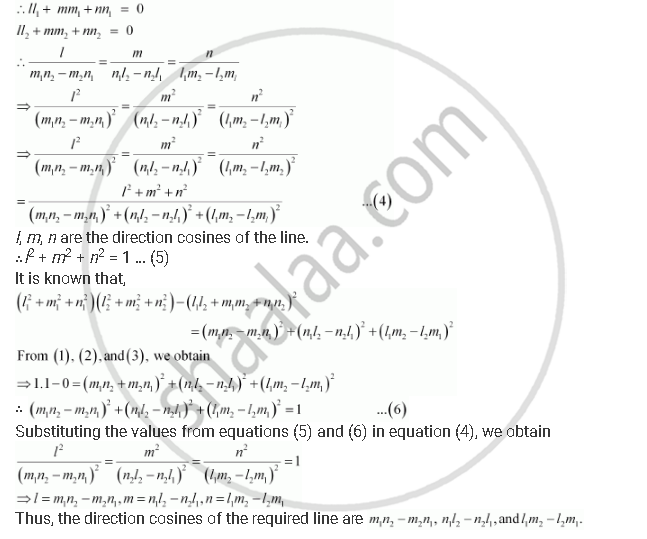
If l1, m1, n1 and l2, m2, n2 are the direction cosines of two mutually perpendicular lines, show that the direction cosines of the line perpendicular to both of these are m1n2 − m2n1, n1l2 − n2l1, l1m2 − l2m1.
Advertisements
उत्तर
It is given that l1, m1, n1 and l2, m2, n2 are the direction cosines of two mutually perpendicular lines. Therefore,
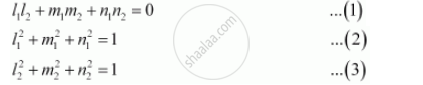
Let l, m, n be the direction cosines of the line which is perpendicular to the line with direction cosines l1, m1, n1 and l2, m2, n2
APPEARS IN
संबंधित प्रश्न
Which of the following represents direction cosines of the line :
(a)`0,1/sqrt2,1/2`
(b)`0,-sqrt3/2,1/sqrt2`
(c)`0,sqrt3/2,1/2`
(d)`1/2,1/2,1/2`
Show that the points (2, 3, 4), (−1, −2, 1), (5, 8, 7) are collinear.
Find the vector equation of the plane passing through (1, 2, 3) and perpendicular to the plane `vecr.(hati + 2hatj -5hatk) + 9 = 0`
If a line makes angles of 90°, 60° and 30° with the positive direction of x, y, and z-axis respectively, find its direction cosines
Find the angle between the vectors whose direction cosines are proportional to 2, 3, −6 and 3, −4, 5.
Show that the points (2, 3, 4), (−1, −2, 1), (5, 8, 7) are collinear.
Show that the line joining the origin to the point (2, 1, 1) is perpendicular to the line determined by the points (3, 5, −1) and (4, 3, −1).
If the coordinates of the points A, B, C, D are (1, 2, 3), (4, 5, 7), (−4, 3, −6) and (2, 9, 2), then find the angle between AB and CD.
Find the angle between the lines whose direction cosines are given by the equations
2l + 2m − n = 0, mn + ln + lm = 0
What are the direction cosines of Y-axis?
Write the distance of the point (3, −5, 12) from X-axis?
Write the ratio in which YZ-plane divides the segment joining P (−2, 5, 9) and Q (3, −2, 4).
A line makes an angle of 60° with each of X-axis and Y-axis. Find the acute angle made by the line with Z-axis.
Write the angle between the lines whose direction ratios are proportional to 1, −2, 1 and 4, 3, 2.
If a line has direction ratios proportional to 2, −1, −2, then what are its direction consines?
Answer each of the following questions in one word or one sentence or as per exact requirement of the question:
Write the distance of a point P(a, b, c) from x-axis.
A parallelopiped is formed by planes drawn through the points (2, 3, 5) and (5, 9, 7), parallel to the coordinate planes. The length of a diagonal of the parallelopiped is
Verify whether the following ratios are direction cosines of some vector or not
`1/5, 3/5, 4/5`
Verify whether the following ratios are direction cosines of some vector or not
`4/3, 0, 3/4`
Find the direction cosines and direction ratios for the following vector
`hat"j"`
Find the direction cosines and direction ratios for the following vector
`5hat"i" - 3hat"j" - 48hat"k"`
A triangle is formed by joining the points (1, 0, 0), (0, 1, 0) and (0, 0, 1). Find the direction cosines of the medians
If `vec"a" = 2hat"i" + 3hat"j" - 4hat"k", vec"b" = 3hat"i" - 4hat"j" - 5hat"k"`, and `vec"c" = -3hat"i" + 2hat"j" + 3hat"k"`, find the magnitude and direction cosines of `3vec"a"- 2vec"b"+ 5vec"c"`
Choose the correct alternative:
The unit vector parallel to the resultant of the vectors `hat"i" + hat"j" - hat"k"` and `hat"i" - 2hat"j" + hat"k"` is
Find the direction cosines of the line passing through the points P(2, 3, 5) and Q(–1, 2, 4).
If a line makes an angle of 30°, 60°, 90° with the positive direction of x, y, z-axes, respectively, then find its direction cosines.
If a variable line in two adjacent positions has direction cosines l, m, n and l + δl, m + δm, n + δn, show that the small angle δθ between the two positions is given by δθ2 = δl2 + δm2 + δn2
If the directions cosines of a line are k,k,k, then ______.
If a line makes angles 90°, 135°, 45° with x, y and z-axis respectively then which of the following will be its direction cosine.
If a line has the direction ratio – 18, 12, – 4, then what are its direction cosine.
The Cartesian equation of a line AB is: `(2x - 1)/2 = (y + 2)/2 = (z - 3)/3`. Find the direction cosines of a line parallel to line AB.
If two straight lines whose direction cosines are given by the relations l + m – n = 0, 3l2 + m2 + cnl = 0 are parallel, then the positive value of c is ______.
If a line makes angles of 90°, 135° and 45° with the x, y and z axes respectively, then its direction cosines are ______.
Any three numbers proportional to the direction cosines of a line are called its:
Which proportion correctly expresses the relationship between direction ratios \[(a,b,c)\] and direction cosines \[(l,m,n)\]?
For points \[P(x_1,y_1,z_1)\] and \[Q(x_2,y_2,z_2)\], which expression gives \[PQ\]?
