Advertisements
Advertisements
प्रश्न
Identify A, B, C in the following reaction sequence:
\[\ce{CH3 - CH = CH2 ->[Br2/CCl4][room temperature] A ->[Zn] B ->[dil. alkaline][KMnO4] C}\]
Advertisements
उत्तर
\[\begin{array}{cc}
\ce{H\phantom{....}H\phantom{...............}}\\
|\phantom{.....}|\phantom{...............}\\
\ce{CH3\underset{Propene}{- CH =} CH2 ->[Br2/CCl4][room temperature] CH3 - C - C - H ->[Zn] CH3 \underset{\overset{Propene}{(B)}}{- CH = C}H2 ->[dil.alkaline][KMnO4] CH3 - CH - CH2}\\
\phantom{........................................}|\phantom{.....}|\phantom{..............................................}|\phantom{......}|\phantom{..}\\
\ce{\phantom{.......................................}\underset{\overset{1,2-Dibromopropane}{(A)}}{Br\phantom{...} Br}\phantom{...........................................}\underset{\overset{Propane-1,2-diol}{(C)}}{OH\phantom{...}OH}}\end{array}\]
APPEARS IN
संबंधित प्रश्न
Identify the main product of the reaction:
\[\ce{HC ≡ C - CH3 ->[H2][Pd-C/quinoline]}\] _______.
Identify the main product of the reaction:
\[\ce{H - C ≡ C - H + H - O ->[{40%} H2SO4][{1%} HgSO4]}\] _____.
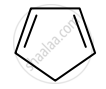
Identify giving reason whether the following compound is aromatic or not.
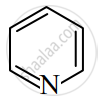
Identify giving reason whether the following compound is aromatic or not.
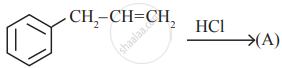
Read the following reaction and answer the questions given below:

- Write the name of the reaction.
- Identify the electrophile in it.
- How is this electrophile generated?
 is
is
Which of the following compounds will not undergo Friedal – crafts reaction easily ? (NEET)
Identify the compound 'Z' in the following reaction
\[\ce{C2H6O ->[Al2O3][623 K] X ->[O3] Y ->[Zn/H2O] (Z)}\]
2 – butyne on chlorination gives ______.
Describe the mechanism of Nitration of benzene.
Suggest a simple chemical test to distinguish propane and propene.
How does Huckel rule help to decide the aromatic character of a compound?
Suggest the route for the preparation of the following from benzene.
Bromo benzene
What happens when ethylene is passed through cold dilute alkaline potassium permanganate.
Write the structure of the following alkanes.
5 – (1, 2 – Dimethyl propyl) – 2 – methylnonane
How will you prepare propane from a sodium salt of fatty acid?
How will distinguish 1 – butyne and 2 – butyne?
Which among the following compounds has highest boiling point?
−Cl group is ____________.
Which of the following is NOT alicyclic compound?
Sodium benzoate on decarboxylation gives ____________.
α-butylene when subjected to hydroboration oxidation reaction, yields ____________.
Conversion of hexane into benzene involves the reaction of ______.
Arenes on treatments with chlorine in the presence of ferric chloride as a catalyst undergo what type of reaction?
Read the following reaction and answer the questions given below.
\[\begin{array}{cc}
\phantom{..............................}\ce{CH3}\\
\phantom{...........................}|\\
\ce{CH3 - C = CH2 + HBr->[Benzoyl][peroxide] H3C - CH - CH2Br}\\
|\phantom{....................................}\\
\ce{CH3}\phantom{.................................}
\end{array}\]
- Write the IUPAC name of the product.
- State the rule that governs the formation of this product.
Read the following reaction and answer the questions given below.
\[\begin{array}{cc}
\phantom{.............................}\ce{CH3}\\
\phantom{...........................}|\\
\ce{CH3 - C = CH2 + HBr ->[benzoyl][peroxide] CH3 - CH - CH2Br}\\
|\phantom{....................................}\\
\ce{CH3}\phantom{.................................}\\
\end{array}\]
- Write IUPAC name of the product.
- State the rule that governs formation of this product.
Read the following reaction and answer the questions given below.
\[\begin{array}{cc}
\phantom{..............................}\ce{CH3}\\
\phantom{............................}|\\
\ce{CH3 - C = CH2 + HBr ->[benzoyl][peroxide] CH3 - CH - CH2Br}\\
|\phantom{....................................}\\
\ce{CH_3}\phantom{.................................}
\end{array}\]
- Write the IUPAC name of the product.
- State the rule that governs the formation of this product.
Read the following reaction and answer the questions given below.
\[\begin{array}{cc}
\phantom{..............................}\ce{CH3}\\
\phantom{............................}|\\
\ce{CH3 - C = CH2 + HBr ->[benzoyl][peroxide] CH3 - CH - CH2Br}\\
|\phantom{....................................}\\
\ce{CH3}\phantom{..................................}
\end{array}\]
- Write IUPAC name of the product.
- State the rule that governs formation of this product.
Which of the following is most stable?
