Advertisements
Advertisements
प्रश्न
Identical springs of steel and copper are equally stretched. On which, more work will have to be done?
Advertisements
उत्तर
Work Done in stretching a Wire or Spring: In stretching a wire work is done against internal restoring forces. This work is stored in the wire as elastic potential energy or strain energy.
If a force F acts along the length L of the wire of cross-section A and stretches it by x, then work done in stretching a wire is given by W = 1/2F × Δl
As springs of steel and copper are equally stretched. Therefore, for the same force (F),
`W ∝ Δl` ......(i)
Young's modulus `(Y) = F/A xx l/(Δl)`
or `Δl = F/A xx l/Y`
As both springs are identical,
∴ `Δl ∝ 1/Y` ......(ii)
From equations (i) and (ii), we get `W ∝ 1/Y`
∴ `W_(steel)/W_(copper) = Y_(copper)/(Y_(steel)) > 1` ......(As `Y_(steel) > Y_(copper)`)
or `W_(steel) > W_(copper)`
Therefore, more work will be done for stretching copper spring.
APPEARS IN
संबंधित प्रश्न
A steel wire of length 4.7 m and cross-sectional area 3.0 × 10⁻⁵ m2 stretches by the same amount as a copper wire of length 3.5 m and cross-sectional area of 4.0 × 10⁻⁵ m2 under a given load. What is the ratio of Young’s modulus of steel to that of copper?
The stress-strain graphs for materials A and B are shown in Figure
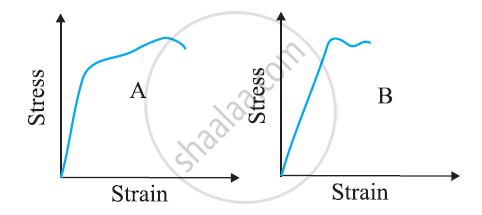
The graphs are drawn to the same scale.
(a) Which of the materials has the greater Young’s modulus?
(b) Which of the two is the stronger material?
A wire elongates by 1.0 mm when a load W is hung from it. If this wire goes over a a pulley and two weights W each are hung at the two ends, he elongation of he wire will be
A steel rod of cross-sectional area 4 cm2 and 2 m shrinks by 0.1 cm as the temperature decreases in night. If the rod is clamped at both ends during the day hours, find the tension developed in it during night hours. Young modulus of steel = 1.9 × 10¹¹ N m−2.
A copper wire of cross-sectional area 0.01 cm2 is under a tension of 20N. Find the decrease in the cross-sectional area. Young modulus of copper = 1.1 × 10¹¹ N m−2 and Poisson ratio = 0.32.
`["Hint" : (Delta"A")/"A"=2(Delta"r")/"r"]`
Young's modulus of a perfectly rigid body is ______.
The temperature of a wire is doubled. The Young’s modulus of elasticity ______.
The Young’s modulus for steel is much more than that for rubber. For the same longitudinal strain, which one will have greater tensile stress?
A truck is pulling a car out of a ditch by means of a steel cable that is 9.1 m long and has a radius of 5 mm. When the car just begins to move, the tension in the cable is 800 N. How much has the cable stretched? (Young’s modulus for steel is 2 × 10¹¹ Nm–2.)
A steel wire of mass µ per unit length with a circular cross section has a radius of 0.1 cm. The wire is of length 10 m when measured lying horizontal, and hangs from a hook on the wall. A mass of 25 kg is hung from the free end of the wire. Assuming the wire to be uniform and lateral strains << longitudinal strains, find the extension in the length of the wire. The density of steel is 7860 kg m–3 (Young’s modules Y = 2 × 10¹¹ Nm–2).
If Y, K and η are the values of Young's modulus, bulk modulus and modulus of rigidity of any material respectively. Choose the correct relation for these parameters.
A metal wire of length L, area of cross section A and Young's modulus Y behaves as a spring of spring constant k given by:
A uniform metal rod of 2 mm2 cross section is heated from 0°C to 20°C. The coefficient of linear expansion of the rod is 12 × 10-6/°C, it's Young's modulus is 1011 N/m2. The energy stored per unit volume of the rod is ______.
If the length of a wire is made double and the radius is halved of its respective values. Then, Young's modules of the material of the wire will ______.
Young's modulus is also known as ______.
What does the dimensional formula [L⁻¹M¹T⁻²] represent?
