Advertisements
Advertisements
प्रश्न
Identical springs of steel and copper are equally stretched. On which, more work will have to be done?
Advertisements
उत्तर
Work Done in stretching a Wire or Spring: In stretching a wire work is done against internal restoring forces. This work is stored in the wire as elastic potential energy or strain energy.
If a force F acts along the length L of the wire of cross-section A and stretches it by x, then work done in stretching a wire is given by W = 1/2F × Δl
As springs of steel and copper are equally stretched. Therefore, for the same force (F),
`W ∝ Δl` ......(i)
Young's modulus `(Y) = F/A xx l/(Δl)`
or `Δl = F/A xx l/Y`
As both springs are identical,
∴ `Δl ∝ 1/Y` ......(ii)
From equations (i) and (ii), we get `W ∝ 1/Y`
∴ `W_(steel)/W_(copper) = Y_(copper)/(Y_(steel)) > 1` ......(As `Y_(steel) > Y_(copper)`)
or `W_(steel) > W_(copper)`
Therefore, more work will be done for stretching copper spring.
APPEARS IN
संबंधित प्रश्न
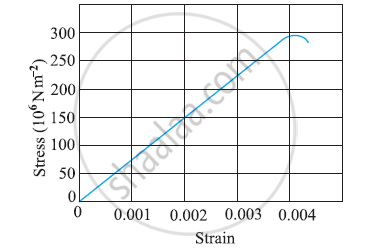
The figure shows the strain-stress curve for a given material. What are (a) Young’s modulus and (b) approximate yield strength for this material?
Read the following statements below carefully and state, with reasons, if it is true or false
The Young’s modulus of rubber is greater than that of steel;
A wire elongates by 1.0 mm when a load W is hung from it. If this wire goes over a a pulley and two weights W each are hung at the two ends, he elongation of he wire will be
A student plots a graph from his reading on the determination of Young modulus of a metal wire but forgets to put the labels. the quantities on X and Y-axes may be respectively
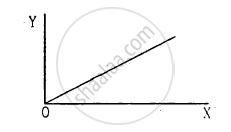
(a) weight hung and length increased
(b) stress applied and length increased
(c) stress applied and strain developed
(d) length increased and the weight hung.
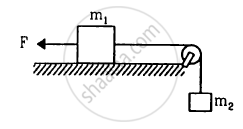
Consider the situation shown in figure. The force F is equal to the m2 g/2. If the area of cross section of the string is A and its Young modulus Y, find the strain developed in it. The string is light and there is no friction anywhere.
A uniform rectangular block of mass of 50 kg is hung horizontally with the help of three wires A, B and C each of length and area of 2m and 10mm2 respectively as shown in the figure. The central wire is passing through the centre of gravity and is made of material of Young's modulus 7.5 x 10¹⁰ Nm−2 and the other two wires A and C symmetrically placed on either side of the wire B are of Young's modulus 1011 Nm−2 The tension in the wires A and B will be in the ratio of:

Young's modulus of a perfectly rigid body is ______.
The temperature of a wire is doubled. The Young’s modulus of elasticity ______.
A steel rod (Y = 2.0 × 10¹¹ Nm–2; and α = 10–50 C–1) of length 1 m and area of cross-section 1 cm2 is heated from 0°C to 200°C, without being allowed to extend or bend. What is the tension produced in the rod?
A steel wire of mass µ per unit length with a circular cross section has a radius of 0.1 cm. The wire is of length 10 m when measured lying horizontal, and hangs from a hook on the wall. A mass of 25 kg is hung from the free end of the wire. Assuming the wire to be uniform and lateral strains << longitudinal strains, find the extension in the length of the wire. The density of steel is 7860 kg m–3 (Young’s modules Y = 2 × 10¹¹ Nm–2).
If the yield strength of steel is 2.5 × 10⁸ Nm–2, what is the maximum weight that can be hung at the lower end of the wire?
If Y, K and η are the values of Young's modulus, bulk modulus and modulus of rigidity of any material respectively. Choose the correct relation for these parameters.
A metal wire of length L, area of cross section A and Young's modulus Y behaves as a spring of spring constant k given by:
If the length of a wire is made double and the radius is halved of its respective values. Then, Young's modules of the material of the wire will ______.
What does the dimensional formula [L⁻¹M¹T⁻²] represent?
In the formula Y = MgL/(πr²l), what does 'l' represent?
The maximum elongation of a steel wire of 1 m length if the elastic limit of steel and its Young’s modulus, respectively, are 8 × 10⁸ Nm−2 and 2 × 10¹¹ Nm−2, is ______.
