Advertisements
Advertisements
प्रश्न
What is the Young’s modulus for a perfect rigid body ?
Advertisements
उत्तर
Young's modulus `(Y) = F/A xx l/(Δl)`
For a perfectly rigid body, change in length `Δl` = 0
∴ `Y = F/A = l/0 = ∞`
Therefore, Young's modulus for a perfectly rigid body is infinite (∞).
APPEARS IN
संबंधित प्रश्न
The stress-strain graphs for materials A and B are shown in Figure
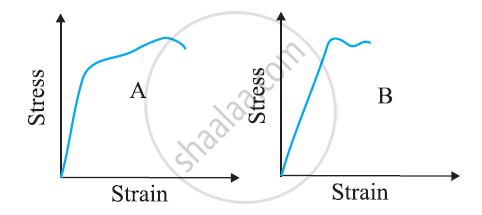
The graphs are drawn to the same scale.
(a) Which of the materials has the greater Young’s modulus?
(b) Which of the two is the stronger material?
Read the following statements below carefully and state, with reasons, if it is true or false
The Young’s modulus of rubber is greater than that of steel;
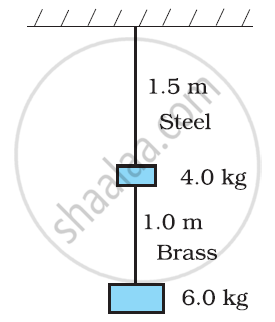
Two wires of diameter 0.25 cm, one made of steel and the other made of brass are loaded as shown in Fig. 9.13. The unloaded length of steel wire is 1.5 m and that of brass wire is 1.0 m. Compute the elongations of the steel and the brass wires.
A 14.5 kg mass, fastened to the end of a steel wire of unstretched length 1.0 m, is whirled in a vertical circle with an angular velocity of 2 rev/s at the bottom of the circle. The cross-sectional area of the wire is 0.065 cm2. Calculate the elongation of the wire when the mass is at the lowest point of its path.
The length of a metal wire is l1 when the tension in it T1 and is l2 when the tension is T2. The natural length of the wire is
Young's modulus of a perfectly rigid body is ______.
The Young’s modulus for steel is much more than that for rubber. For the same longitudinal strain, which one will have greater tensile stress?
A truck is pulling a car out of a ditch by means of a steel cable that is 9.1 m long and has a radius of 5 mm. When the car just begins to move, the tension in the cable is 800 N. How much has the cable stretched? (Young’s modulus for steel is 2 × 10¹¹ Nm–2.)
A steel wire of mass µ per unit length with a circular cross section has a radius of 0.1 cm. The wire is of length 10 m when measured lying horizontal, and hangs from a hook on the wall. A mass of 25 kg is hung from the free end of the wire. Assuming the wire to be uniform and lateral strains << longitudinal strains, find the extension in the length of the wire. The density of steel is 7860 kg m–3 (Young’s modules Y = 2 × 10¹¹ Nm–2).
If the yield strength of steel is 2.5 × 10⁸ Nm–2, what is the maximum weight that can be hung at the lower end of the wire?
In nature, the failure of structural members usually result from large torque because of twisting or bending rather than due to tensile or compressive strains. This process of structural breakdown is called buckling and in cases of tall cylindrical structures like trees, the torque is caused by its own weight bending the structure. Thus the vertical through the centre of gravity does not fall within the base. The elastic torque caused because of this bending about the central axis of the tree is given by `(Ypir^4)/(4R) . Y` is the Young’s modulus, r is the radius of the trunk and R is the radius of curvature of the bent surface along the height of the tree containing the centre of gravity (the neutral surface). Estimate the critical height of a tree for a given radius of the trunk.
A metal wire of length L, area of cross section A and Young's modulus Y behaves as a spring of spring constant k given by:
A boy's catapult is made of rubber cord which is 42 cm long, with a 6 mm diameter of cross-section and negligible mass. The boy keeps a stone weighing 0.02 kg on it and stretches the cord by 20 cm by applying a constant force. When released, the stone flies off with a velocity of 20 ms-1. Neglect the change in the area of the cross-section of the cord while stretched. Young's modulus of rubber is closest to ______.
If the length of a wire is made double and the radius is halved of its respective values. Then, Young's modules of the material of the wire will ______.
The force required to stretch a wire of cross section 1 cm2 to double its length will be ______.
(Given Young's modulus of the wire = 2 × 10¹¹ N/m2)
What is longitudinal strain?
Which of the following statements about Young's modulus is correct?
The maximum elongation of a steel wire of 1 m length if the elastic limit of steel and its Young’s modulus, respectively, are 8 × 10⁸ Nm−2 and 2 × 10¹¹ Nm−2, is ______.
