Advertisements
Advertisements
प्रश्न
Humans are ______.
विकल्प
oviparous
viviparous
ovoviviparous
Advertisements
उत्तर
Humans are viviparous.
Explanation:
Sexually reproducing organisms like humans that give birth to young ones directly. In this case, the development of the zygote occurs within the body of the organism. Such organisms are called viviparous.
संबंधित प्रश्न
What are the major functions of male accessory ducts and glands?
Given below is the schematic diagram of the sectional view of the human male reproductive system.
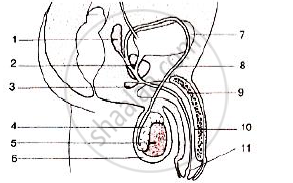
Name the parts numbered 1-11.
Given below is the schematic diagram of the sectional view of the human male reproductive system.

State the functions of the parts numbered 1, 2, 3, 5, 8 and 11.
Give Technical Term:
Name the male gamete of a mammal.
State the Location:
Cowper’s glands
Write the functional activity of the following structure:
Testis
State names of organs in male reproductive system.
Identify the primary sex organs in males.
Which of the following correctly describes the rete testis?
In the male reproductive system, the vasa deferens joins the ____________.
Which of the following is a transporting tube leading from the bladder to which brings urine outside the body via penis?
The enlarged end of penis is covered by a loose fold of skin is called ______.
In human males, the testes lie in the scrotum, because it helps in the
Accessory glands of male reproductive system are
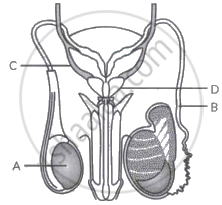
Identify A, B, C, D, in the given diagram of the human reproductive system:
Explain the function of the following structure in the human male reproductive system.
Male accessory glands
In humans, sperm production occurs in the organ ______.
The figure given below is an important gonad of humans. Study the figure and answer the following questions.
 |
- Identify the organ. Write its specific location in the body.
- Label the parts shown in the figure as 1 to 4.
- Write important functions of parts 2 and 4.
- Name one cellular structure and one hormone which are produced in part 3.
- Draw a neat and labelled diagram of the cellular structure mentioned by you in (d).
Which accessory ducts are responsible for sperm transport and maturation in their correct sequence?
Each testis is divided into approximately how many compartments called testicular lobules?
