Advertisements
Advertisements
प्रश्न
Hamid’s friends are ______
विकल्प
Mahmood, Mohsin, Noorey and Sammi.
Raghul, Preethi, Sam and Mufeed.
Rani, Verghese, Sita and Zahir.
Advertisements
उत्तर
Hamid’s friends are Mahmood, Mohsin, Noorey and Sammi.
APPEARS IN
संबंधित प्रश्न
How does the nightingale's song plunge the poet into a state of ecstasy?
Go through the text again and find the reasons that forced Peter to shoot down a person.
- The keepers spotted him.
- _________________________
- _________________________
What are the clothes compared to? Give two examples.
Form groups and hold debates on the following topics. Make bulleted lists of points in favour of the topic (pros) and those against it (cons). (3-6 points each)
You should never lose a match.
Make groups. One person in the group chooses an announcement. Everyone in the group reads that announcement silently but carefully and closes their books. Then that person presents the announcement, changing one of the details in the announcement. Others spot the change. For example, you might say ‘red’ key chain instead of ‘blue’ in the last announcement.
Read the data below and answer the following question.
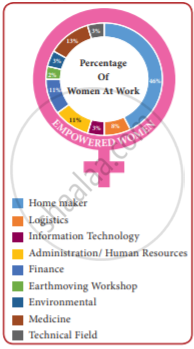
Choose the correct answer.
In which field of work is women’s involvement the second highest?
Read the following article about the amazing similarities between the assassination of John F. Kennedy and Abraham Lincoln; then underline the passive forms.
Abraham Lincoln was elected to Congress in 1846. Voters elected John F. Kennedy to Congress in 1946.
Lincoln was elected president in 1860. Voters elected Kennedy president in 1960.
Both men were particularly concerned with civil rights.
Both wives lost their children while living in the White House.
Lincoln was shot on a Friday. Someone shot Kennedy on a Friday.
Lincoln was shot in the head. The gunman shot Kennedy in the head.
Lincoln’s secretary was called Kennedy. Kennedy’s secretary was called Lincoln.
Lincoln was assassinated by a Southerner. A Southerner assassinated Kennedy.
Lincoln was succeeded by a Southerner named Johnson. A Southerner named Johnson succeeded Kennedy.
Andrew Johnson, who succeeded Lincoln, was born in 1808.
Lyndon Johnson, who succeeded Kennedy, was born in 1908.
John Wilkes Booth, who assassinated Lincoln, was born in 1839. Lee Harvey Oswald, who assassinated Kennedy, was born in 1939.
Both assassins were known by their three names and both names are composed of fifteen letters.
Lincoln was shot at a theatre named “Ford”. The gunman shot Kennedy in a car called a “Lincoln” that the company Ford made.
Booth ran from the theatre and was caught in a warehouse. Oswald ran from a warehouse and the police caught him in a theatre.
Booth was assassinated before his trial. Someone assassinated Oswald before his trial.
Why did the family move to Patna?
Anitha's friends wanted a______ robot in their houses.
Pick out word which mean the same as
keep a check on (para 3)
