Advertisements
Advertisements
प्रश्न
Going across a period left to right, atomic size _____.
Advertisements
उत्तर
Going across a period left to right, atomic size Decrease.
Atomic size gradually decreases from left to right across a period of elements. ... This means that the nucleus attracts the electrons more strongly, pulling the atom's shell closer to the nucleus. The valence electrons are held closer towards the nucleus of the atom. As a result, the atomic radius decreases
APPEARS IN
संबंधित प्रश्न
Use the letters only written in the Periodic Table given below to answer the questions that Follow:
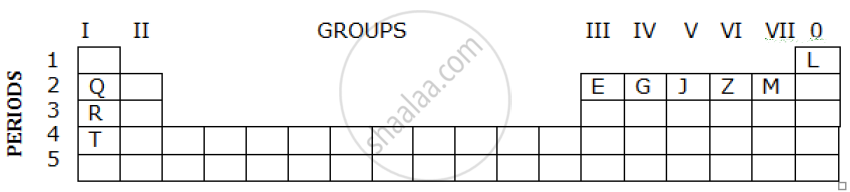
- State the number of valence electrons in atom J.
- Which element shown forms ions with a single negative charge?
- Which metallic element is more reactive than R?
- Which element has its electrons arranged in four shells?
Calculate the mass of Calcium that will contain the same number of the atom as are present in 3.2 gm of Sulphur.
[Atomic masses: S=32, Ca=40]
An element Z has atomic number 16. Answer the following questions on Z:
- State the period and group to which Z belongs.
- Is Z a metal or a non-metal?
- State the formula between Z and hydrogen.
- What kind of a compound is this?
In the following set of elements, one element does not belong to the set. Select this element and state why it does not belong:
Oxygen, Nitrogen, Carbon, Chlorine, Fluorine
How does the electropositive character of elements change on going down in a group of the periodic table?
State one reason for keeping fluorine and chlorine in the same of the periodic table.
Write two reasons responsible for the late discovery of noble gases?
On the basis of electronic configuration, how will you identify the first and the last element of a period?
Parts (i) to (v) refer to changes in the properties of elements on moving from left to right across a period of the periodic table. For each property, choose the letter corresponding to the correct answer from the choices (a), (b), (c) and (d).
(i) The non metallic character of the elements:
(a) Decreases
(b) Increases
(c) Remains the same
(d) Depends on the period
(ii) The electro negativity
(a) Depends on the number of valence electrons
(b) Remains the same
(c) Decreases
(d) Increases
(iii) The ionization potential
(a) Goes up and down
(b) Decreases
(c) Increases
(d) Remains the same
(iv) The atomic size
(a) Decreases
(b) Increases
(c) Remains the same
(d) Sometimes increases and sometimes decreases
(v) The electron affinity of the elements in groups 1 to 7:
(a) Goes up and down
(b) Decreases and then increases
(c) Increases
(d) decreases
Give a reason for the following:
A transition from metallic to non-metallic elements is seen on moving from left to right in a period of the periodic table.
