Advertisements
Advertisements
प्रश्न
The position of elements A, B, C, D and E in the periodic table are shown below:
|
Group 1 |
Group 2 |
Group 17 |
Group 18 |
|
|
|
|
D |
|
|
B |
C |
|
|
A |
|
|
E |
Which is larger in size (i) D or E (ii) B or C
Advertisements
उत्तर
E
B
APPEARS IN
संबंधित प्रश्न
The atomic numbers of three elements A, B and C are 12, 18 and 20 respectively. State, giving reason, which two elements will show similar properties.
List any two properties of the elements belonging to the first group of the modern periodic table.
Write the atomic numbers of two elements 'X' and 'Y' having electronic configuration 2, 8, 2 and 2, 8, 6 respectively.
Rewrite the following statement after correction, if necessary:
Elements in the same period have equal valency
Given alongside is a part of the periodic table. As we move vertically downward from Li to fr?
| Li | Be |
| Na | |
| K | |
| Rb | |
| Cs | |
| Fr | |
| rA | Ra |
What happens to the size of atoms?
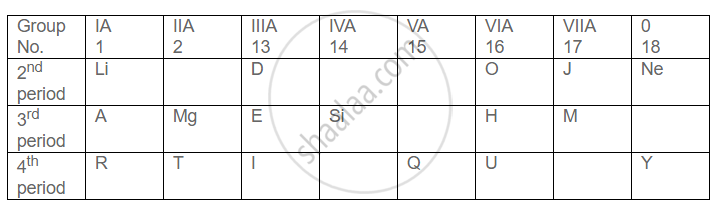
In the above table, H does not represent hydrogen.Some elements are given in their own symbol and position in the periodic table while others are shown with a letter. With refrence to the table answer the following questions.
1. Identify the most electronegative element.
2. Identify the most reactive element of Group I.
3. Identify the element from Period 3 with least atomic size.
4. How many valence electrons are present in Q?
5. Which element from group 2 would have the least ionisation energy?
6. Identify the noble gas of the fourth period.
7. In the compound between A and H, what type of bond would be formed and give its molecular formula.
Element P has atomic number 19. To which group and period, does P belong? Is it a metal or a non-metal? Why?
Fill in the blank and rewrite the completed statement:
________ group in the periodic table contains elements that are all gases at room temperature.
Name or state following with reference to the element of the first three periods of the periodic table.
A non-metal in period 2 having electronic configuration 2, 6.
Name or state following with reference to the element of the first three periods of the periodic table.
A metal in period 3 having valency 3.
