Advertisements
Advertisements
प्रश्न
The position of elements A, B, C, D and E in the periodic table are shown below:
|
Group 1 |
Group 2 |
Group 17 |
Group 18 |
|
|
|
|
D |
|
|
B |
C |
|
|
A |
|
|
E |
Which is larger in size (i) D or E (ii) B or C
Advertisements
उत्तर
E
B
APPEARS IN
संबंधित प्रश्न
The atomic numbers of three elements A, B and C are 12, 18 and 20 respectively. State, giving reason, which two elements will show similar properties.
An element 'X' has mass number 35 and number of neutrons 18. Write atomic number and electronic configuration of 'X'. Also write group number, period number and valency of 'X'.
Use the letters only written in the Periodic Table given below to answer the questions that Follow:
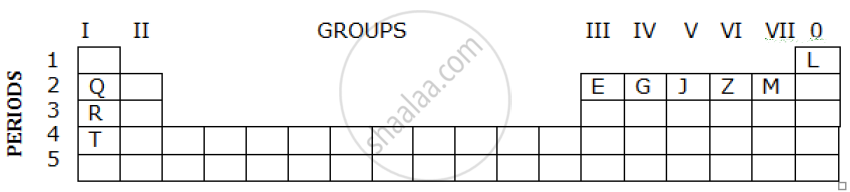
- State the number of valence electrons in atom J.
- Which element shown forms ions with a single negative charge?
- Which metallic element is more reactive than R?
- Which element has its electrons arranged in four shells?
Fill in the blank in the following statement:
The tendency to gain an electron ............... on moving down in a group of the periodic table.
An element 'M' has atomic number 11.
(a) Write its electronic configuration.
(b) State the group to which 'M' belongs.
(c) Is 'M' a metal or a non-metal.
(d) Write the formula of its chloride.
How can the valency of an element be determined if its electronic configuration is known?
Study the extract of the Periodic Table given below and answer the questions that follow. Give the alphabet corresponding to the element in question. DO NOT repeat an element. 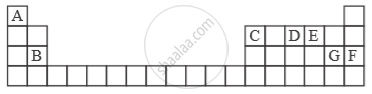
The ion of which element will migrate towards the cathode during electrolysis?
Arrange the following as per instruction given in the bracket
Na, K, Cl, S, Si (increasing ionisation potential)
Name and state the following with reference to the elements of the first three periods of the periodic table.
Valency of elements in Group 14 and 15.
Fill in the blank and rewrite the completed statement:
________ group in the periodic table contains elements that are all gases at room temperature.
