Advertisements
Advertisements
प्रश्न
Given reasons: C–Cl bond length in chlorobenzene is shorter than C–Cl bond length in CH3–Cl.
Advertisements
उत्तर
In chlorobenzene, the C−Cl bond gets partial double bond character because of the +M effect shown by the Cl group. Due to double bond character, the bond length decreases in chlorobenzene as compared to the normal CH3−Cl bond length. Therefore, the C–Cl bond length in chlorobenzene is shorter than the C–Cl bond length in CH3–Cl.
संबंधित प्रश्न
Out of  , which is more reactive towards SN1 reaction and why?
Write the structure of the major organic product in the following reaction:
\[\ce{CH3CH2Br + KCN ->[aq{.} ethanol]}\]
The stability order for carbocation is _______.
(A) 2° > 3° > 1°
(B) 3° > 2° > 1°
(C) 3° > 1° > 2°
(D) 1° > 3° > 2°
The process of separation of a racemic modification into d and l-enantiomers is called ____________.
Optical activity of an enantiomeric mixture is +12.6° and the specific rotation of (+) isomer is +30°. The optical purity is ______ %.
Retention of configuration is observed in ______.
Identify the product in the following reaction: 
Discuss SN2 mechanism of methyl bromide using aqueous KOH.
Explain why Grignard reagents should be prepared under anhydrous conditions.
The correct order of increasing reactivity of
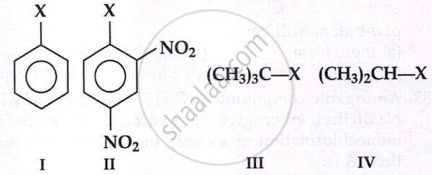
C-X bond towards nucleophile in the following compounds is:
