Advertisements
Advertisements
प्रश्न
Given below is the simplified pathway of the circulatory system:
(i) Name the blood vessels marked 1 to 8.
(ii) Name the chamber of the heart which:
(a) Receives blood from ‘1’.
(b) Pumps blood into blood vessel ‘8’.
(iii) Mention two structural differences between blood vessels ‘7’ and ‘2’.
Advertisements
उत्तर
(i)
1. Pulmonary vein
2. Dorsal aorta,
3. Hepatic portal vein
4. Renal artery
5. Iliac vein
6. Hepatic vein
7. Inferior vena-cava
8. Pulmonary artery.
(ii) (a) Left auricle.
(b) Right ventricle.
(iii) (a) The inferior vena cava arises from iliac veins coming from the hind limbs, while the dorsal aorta arises from the left ventricle and continues behind as the abdominal aorta.
(b) The deoxygenated blood is collected by the inferior vena cava, while the branches of the dorsal aorta supply oxygenated blood to the body parts.
संबंधित प्रश्न
The diagram below represents the simplified pathway of the circulation of blood. Study the same and answer the questions which follow:

(i) Name the blood vessels labelled 1 and 2.
(ii) State the function of blood vessels labelled 5 and 8.
(iii) What is the importance of the blood vessel labelled 6?
(iv) Which blood vessel will contain a high amount of glucose and amino acids after a meal?
(v) Draw a diagram of the different blood cells as seen in a smear of human blood.
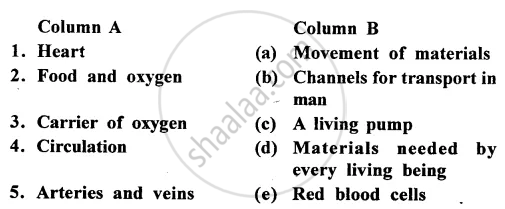
Match the statements in Column A with those in Column B:
The nearest organ to which the heart supplies oxygenated blood is:
Give reason for the following:
The walls of the left ventricle are thicker than the walls of all other chambers.
Why does the left ventricle possess a thicker wall than the right ventricle?
Write a short note on the human heart.
Complete the following sentence with appropriate word:
The foundations of physiology were laid by the physician __________.
______ WBCs are present per mm3 of blood.
In a closed circulatory system, blood is completely enclosed within:
Name these:
Three components of circulatory system.
