Advertisements
Advertisements
प्रश्न
The diagram below represents the simplified pathway of the circulation of blood. Study the same and answer the questions which follow:

(i) Name the blood vessels labelled 1 and 2.
(ii) State the function of blood vessels labelled 5 and 8.
(iii) What is the importance of the blood vessel labelled 6?
(iv) Which blood vessel will contain a high amount of glucose and amino acids after a meal?
(v) Draw a diagram of the different blood cells as seen in a smear of human blood.
Advertisements
उत्तर
(i)
1– Superior vena cava
2 – Aorta
(ii) Function of blood vessel 5 (Hepatic artery) – It supplies oxygenated blood to the liver.
Function of blood vessel 8 (Inferior vena cava) – It carries deoxygenated blood from the posterior parts of the body to the heart.
(iii) Importance of blood vessel 6 (Hepatic portal vein) – It carries nutrient laden blood from the gastrointestinal tract to the liver.
(iv) Blood vessel 6, i.e. hepatic portal vein.
(v) Different blood cells seen in a smear of human blood:

संबंधित प्रश्न
Why is blood needed by all the parts of a body?
Aqueous humour, Vitreous humour, lris, Central canal
Give biological reasons for the following statements:
The left ventricle of the heart has a thicker wall than the right ventricle.
The vein that carries oxygenated blood.
The diagram given below represents the human heart in one phase of its functions. Study the diagram carefully and answer the questions that follow:
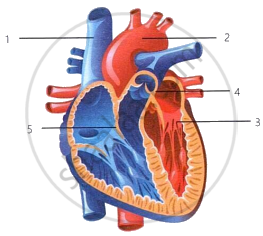
- Name the phase.
- Which part of the heart is contracting in this phase? Give a reason to support your answer.
- Name the parts labelled 1 to 4.
- What type of blood flows through 2?
- State the function of the part numbered ‘5’.
- Name the membrane that covers the heart.
Explain Diapedesis.
Differentiate between members of the following pairs with reference to the aspect asked
within bracket:
Erythrocytes and leucocytes (function)
Match the statements in Column A with those in Column B
| Column A | Column B | ||
| 1 | Heart | a | Movement of materials |
| 2 | Food and oxygen | b | Channels for transport in man |
| 3 | Carrier of oxygen | c | A living pump |
| 4 | Circulation | d | Materials needed by every living being |
| 5 | Arteries and veins | e | Red blood cells |
Draw the structure of human heart and label its parts
Which of the following cells are produced from reticulocytes?
