Advertisements
Advertisements
प्रश्न
Given below is a schematic diagram to illustrate some aspects of photosynthesis.
- Fill up the gaps, in blank spaces (1-4), by writing the names of the correct items.
- What phenomenon do the thick arrows A and B indicate?

Advertisements
उत्तर
-
- Sunlight
- Oxygen
- Glucose
- Xylem
-
- Transpiration
- Translocation
APPEARS IN
संबंधित प्रश्न
An experiment was set up as shown in the figure given below . The twig in the diagram was intact on the plant and it was as such in sunlight for a few hours .
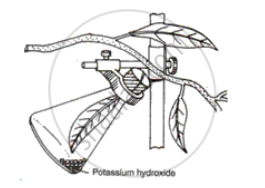
(i) What is the aim of the above experiment ?
(ii) Why was potassium hydroxide placed inside the conical flask ?
(iii) What test would you perform on the leaf inside the flask?
(iv) What is the expected result of the above test ?
(v) Is it necessary to similarly test on outer leaf also ? Giva a reason .
Complete the following statement by choosing the correct alternative given below :
All animals would die on the earth if there was no ______.
The chemical substance used to test the presence of starch in the cell of a leaf is ______.
How would you demonstrate that green plants release oxygen when exposed to light?
Photosynthesis in green plants is directly and indirectly dependent on so many plant structures.
Explain briefly the role of the following structures in this process Guard cells.
Photosynthesis in green plants is directly and indirectly dependent on so many plant structures.
Explain briefly the role of the following structures in this process is Cuticle.
Photosynthesis in green plants is directly and indirectly dependent on so many plant structures.
Explain briefly the role of the following structures in this process is Xylem tissue in the leaf veins
Given below is the representation of a certain phenomenon in nature. With four organisms 1-4.

- Name the phenomenon represented.
- Name any one organism that could be shown at No. 5.
- Name the biological process which was the starting point of the whole chain.
- Name one natural element which all the organisms 2-4 and even 5 are getting from No. 1 for their survival.
Where are the chlorophyll pigments present in a cell?
Why Is Photosynthesis Important in Nature?
