Advertisements
Advertisements
प्रश्न
Photosynthesis in green plants is directly and indirectly dependent on so many plant structures.
Explain briefly the role of the following structures in this process Guard cells.
Advertisements
उत्तर
Guard cells: They regulate the opening and closing of stomata and thus regulate the entry of carbon dioxide through the stomata.
संबंधित प्रश्न
Mention one difference between the following on the basis of what is given in bracket.
Chlorophyll and chloroplast (part of plant cell)
The chemical substance used to test the presence of starch in the cell of a leaf is ______.
Given below is a schematic diagram to illustrate some aspects of photosynthesis.
- Fill up the gaps, in blank spaces (1-4), by writing the names of the correct items.
- What phenomenon do the thick arrows A and B indicate?

Given below is the representation of a certain phenomenon in nature. With four organisms 1-4.
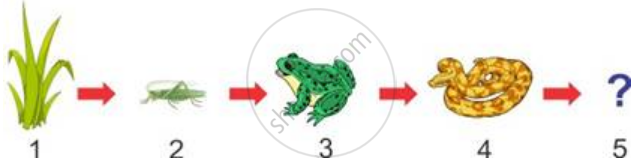
Name one natural element which all the organisms 2-4 and even 5 are getting from No. 1 for their survival.
Given alongside is the diagram of an experimental set-up:
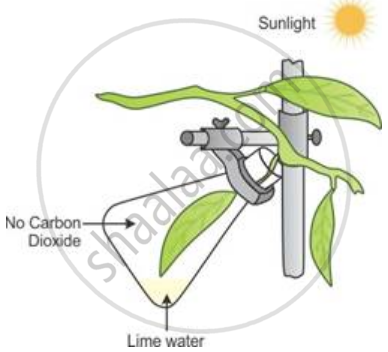
What alteration (s) will you make in it for obtaining expected result?
A potted plant was taken in order to prove a factor necessary for photosynthesis. The potted plant was kept in the dark for 24 hours. One of the leaves was covered with black paper in the centre. The potted plant was then placed in sunlight for a few hours.
Why was the plant placed in the dark before beginning the experiment?
Why Is Photosynthesis Important in Nature?
Choose the Odd One Out
Write the overall chemical equation for photosynthesis.
Given below is the diagram of an experimental set-up (final stage). Study the same and answer the following questions:

- What is the main aim of the experiment?
- Oxygen gas shown in the experiment is released from which of the raw materials?
- How would you confirm the presence of oxygen gas?
- Name the chemical substance which can be added in water to enhance the process/rate of release of oxygen gas.
- Draw a neat and labelled diagram of the same experiment for its initial stage.
