Given alongside are two figures (A and B) representing the two stages of evolution of human beings. Answer the following: Mention any two contrasting characters between the two stages.
Advertisements
प्रश्न
Given alongside are two figures (A and B) representing the two stages of evolution of human beings.
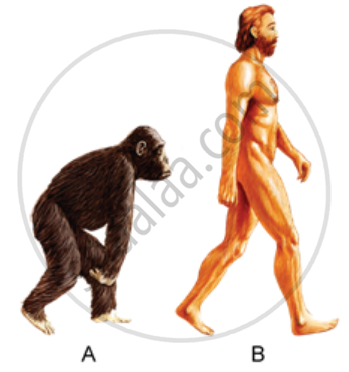
Answer the following:
- Mention any two contrasting characters between the two stages.
- Write all the stages of human evolution in their correct sequence.
- State any two characteristic features of stage B.
Advertisements
उत्तर
(a) Stage A: Australopithecus
Stage B: Homo sapiens sapiens
Contrasting characters between Australopithecus and Homo sapiens sapiens:
| Characters | Australopithecus | Homo sapiens sapiens |
| Cranial capacity | 450 to 600 cm3 | 1450 to 1600 cm3 |
| Development of chin | Lack of chin, prognathous face. | Prominent chin and snout disappeared. |
(b) Stages of human evolution in their correct sequence:
Australopithecus > Homo habilis > Homo erectus > Neanderthal man > Cro-Magnon man > Modern man/Homo sapiens sapiens.
(c) Characteristic features of stage B (Homo sapiens sapiens):
- Bipedal locomotion with four reversed curves in the spine.
- Forehead steep, reduced brow ridges.
APPEARS IN
संबंधित प्रश्न
Define ‘reproductive isolation’ and explain two types of reproductive isolation.
The range of cranial capacities in the following ancestral forms were
Homo sapiens sapiens ______.
What is the law of dominance of traits? Explain with an example.
Write a note on Homo habilis
Identify the fossil man whose remains were discovered in the Shivalik hills in India?
All are features of Homo erectus, EXCEPT
Australopithecus was first discovered in which place?
The long, prehensile tail of an arboreal animal is an adaptation for ______
Which of the following is an example for link species?
We are told that evolution is a continuing phenomenon for all living things. Are humans also evolving? Justify your answer.
