Advertisements
Advertisements
प्रश्न
We are told that evolution is a continuing phenomenon for all living things. Are humans also evolving? Justify your answer.
Advertisements
उत्तर
Yes, human is also evolving. Fossils give the evidences that evolution is a continuous phenomenon. Our ancestors like Ramapithecus, Australopithecus, Homo habilis, Homo erectus, Neanderthal man and Cro-magnon man continuously evolving and modem man (Homo sapiens sapiens) arises from certain modifications.
APPEARS IN
संबंधित प्रश्न
In evolutionary terms, can we say which among bacteria, spiders, fish and chimpanzees have a ‘better’ body design? Why or why not?
What are the four blood groups in humans?
The first remarkable human fossil was that of ______.
Given alongside are two figures (A and B) representing the two stages of evolution of human beings.
Answer the following:
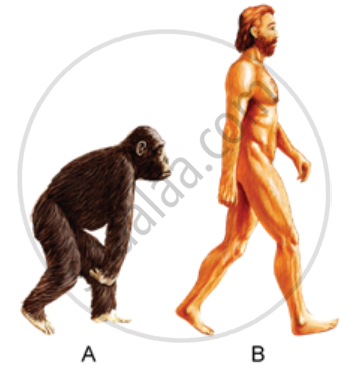
State any two characteristic features of stage B.
Write two differences between Homo erectus and Homo habilis
Write a note on Homo habilis
Complete the table based on the special features of Human ancestors showing their cultural and social development.
| Ancestors | Special features |
| Homo erectus | |
| Buried their dead | |
| Made tools from stones |
Complete the following analogy.
______ : Man-like :: Dryopithecus : Ape-like hairy primate
Match the following.
| Column I | Column II | ||
| i. | Homo habilis | p. | 900 cc |
| ii. | Australopithecus | q. | 1350 cc |
| iii. | Homo erectus | r. | 650 - 800 cc |
| iv. | Homo sapiens | s. | 450-600 cc |
Select the correct option.
The first fossils of Dtyopithecu were found in ______.
Identify the character which is most relatable to Neanderthal man?
Match column - I with column - II and select the correct option.
| Column - I | Column - II | ||
| (a) | Propliopithecus | (i) | Miocene |
| (b) | Homoerectus pekinensis | (ii) | Early Pleistocene |
| (c) | Dryopithecus | (iii) | Middle Pleistocene |
| (d) | Australopithecus | (iv) | Oligocene |
A cross between a tall pea-plant (TT) and a short pea-plant (tt) resulted in progenies that were all tall plants because ______
In question 44, what are the combinations of character in the F2 progeny? What are their ratios?
What was the most significant trend in the evolution of modern man (Homo sapiens) from his ancestors?
Write any eight major changes that occurred in human evolution.
Which one of the following pair is mismatched regarding their appearance in human evolution?
Complete the following analogy with respect to classification of mammals.
Marsupials : (i) : : monotremes : (ii)
What was the primary geographic region where man-like primates that walked upright lived approximately 3-4 million years ago?
How are the evolutionary stages of human development traced by paleontologists?
