Given alongside are two figures (A and B) representing the two stages of evolution of human beings. Answer the following: Mention any two contrasting characters between the two stages.
Advertisements
प्रश्न
Given alongside are two figures (A and B) representing the two stages of evolution of human beings.
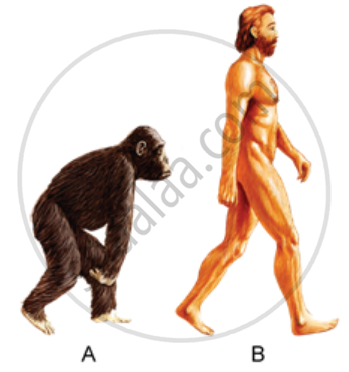
Answer the following:
- Mention any two contrasting characters between the two stages.
- Write all the stages of human evolution in their correct sequence.
- State any two characteristic features of stage B.
Advertisements
उत्तर
(a) Stage A: Australopithecus
Stage B: Homo sapiens sapiens
Contrasting characters between Australopithecus and Homo sapiens sapiens:
| Characters | Australopithecus | Homo sapiens sapiens |
| Cranial capacity | 450 to 600 cm3 | 1450 to 1600 cm3 |
| Development of chin | Lack of chin, prognathous face. | Prominent chin and snout disappeared. |
(b) Stages of human evolution in their correct sequence:
Australopithecus > Homo habilis > Homo erectus > Neanderthal man > Cro-Magnon man > Modern man/Homo sapiens sapiens.
(c) Characteristic features of stage B (Homo sapiens sapiens):
- Bipedal locomotion with four reversed curves in the spine.
- Forehead steep, reduced brow ridges.
APPEARS IN
संबंधित प्रश्न
A human gamete contains ______ chromosomes whereas a normal body cell has ______ chromosomes in it.
The range of cranial capacities in the following ancestral forms were
Homo habilis ______.
Evolution is an ever ______ process.
Distinguish between Australopithecus and Neanderthal man
Amongst the following which is a character of Australopithecus?
Does geographical isolation of individuals of a species lead to formation of a new species? Provide a suitable explanation.
Match the columns:
| Human Stage | Cranial Capacity | ||
| (1) | Homo sapiens | (a) | 650-800 cc |
| (2) | Homo neanderthal | (b) | 900 cc |
| (3) | Homo habilis | (c) | 1400 cc |
| (4) | Homo erectus | (d) | 1450 cc |
Define the following term:
Bipedalism
Which stage of human evolution lived in East African grasslands and hunted with stone tools approximately 2 million years ago?
Where did Homo sapiens (modern man) originate?
