Advertisements
Advertisements
प्रश्न
Given below are two figures (A and B) showing a phenomenon that was first observed in Manchester before and after the year 1850.
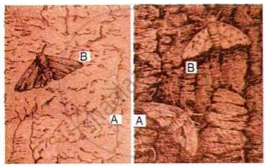
Answer the following:
- What name has been given to this phenomenon?
- Give the common name and the scientific name of the insect involved in this phenomenon.
- Briefly mention why the changes shown in the two figures appeared.
- The following phenomenon provides a classical explanation of a scientific theory given by a certain scientist.
- Name and explain the said theory.
- Give the name of the scientist who gave this theory.
थोडक्यात उत्तर
सविस्तर उत्तर
Advertisements
उत्तर
- Industrial melanism.
-
- Common name: peppered moth.
- Scientific name: Biston betularia.
- The changes shown in the figure appear because:
- Before the Industrial Revolution in England, light-coloured moths were more common because tree trunks were light-coloured and covered with lichens.
- On these light backgrounds, light-coloured moths were well camouflaged, while dark-coloured moths were easily seen and eaten by predators.
- After industrialisation, soot and smoke darkened the tree trunks and destroyed the lichens.
- Dark-coloured moths then became better camouflaged, while light-coloured moths became more visible to predators.
- Therefore, dark-coloured moths survived and reproduced in greater numbers. This is an example of natural selection.
-
- Natural selection: During the struggle for existence, organisms possessing favourable variations have a better chance of surviving and reproducing. Nature selects the variations best suited to the environment. This process is called natural selection.
- The theory of natural selection was proposed by Charles Darwin.
shaalaa.com
या प्रश्नात किंवा उत्तरात काही त्रुटी आहे का?
