Advertisements
Advertisements
प्रश्न
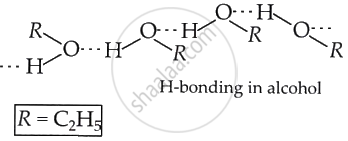
Give reason for the higher boiling point of ethanol in comparison to methoxymethane.
Advertisements
उत्तर
Ethanol undergoes intermolecular H-bonding due to the presence of −OH group, resulting in the association of molecules. Extra energy is required to break these hydrogen bonds. On the other hand, methoxymethane does not undergo H-bonding. Therefore, ethanol has a higher boiling point than methoxymethane.

APPEARS IN
संबंधित प्रश्न
Give reasons for the following: Butan-1-ol has a higher boiling point than diethyl ether.
Give reasons for the following : Boiling point of ethanol is higher in comparison to methoxymethane.
Alcohols are comparatively more soluble in water than hydrocarbons of comparable molecular masses. Explain this fact.
Arrange the following compounds in the increasing order of their acid strength:
p-cresol, p-nitrophenol, phenol
Write the structures of A, B and C in the following reactions :
\[ C_6 H_5 {NO}_2 \to^{Sn/HCI} A \to^{{NaNO}_2 /HCI}_{273 K} B \to^{H_2 O}_∆ C\]
Write a chemical reaction to show that the open structure of D-glucose contains the following :
Five alcohol groups
Alcohols have high boiling points because of ____________.
Isopropyl alcohol is obtained by reacting which of the following alkenes with concentrated H2SO4 followed by boiling with H2O?
Which statement is not correct about alcohol?
Which one of the following alcohols is least soluble in water?
Explain why alcohols and ethers of comparable molecular mass have different boiling points?
A solution of phenol in chloroform when treated with aqueous NaOH gives compound P as a major product. The mass percentage of carbon in P is ______. (to the nearest integer) (Atomic mass: C = 12; H = 1; O = 16)
Assertion (A): Alcohols react both as nucleophiles and electrophiles.
Reason (R): The bond between C–O is broken when alcohols react as nucleophiles.
Select the most appropriate answer from the options given below:
Write a note on Kolbe's reaction
How are the following conversions carried out?
Methyl magnesium bromide → 2 -Methylpropan-2-ol.
How are the following conversions carried out?
\[\ce{Methyl magnesium bromide ->2-Methylpropan-2-ol}\]
How are the following conversions carried out?
\[\ce{Methyl magnesium bromide -> 2-Methylpropan-2-ol}\]