Advertisements
Advertisements
प्रश्न
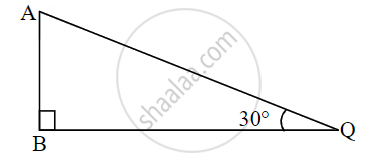
From the given figure, in ∆ABQ, if AQ = 8 cm, then AB =?

Advertisements
उत्तर
In ∆ABQ,
∠B = 90°, ∠Q = 30° ...[Given]
∴ ∠A = 60° ...[Remaining angle of a triangle]
∴ ∆ABQ is a 30°–60°–90° triangle.
∴ AB = `1/2` AQ ....[Side opposite to 30°]
∴ AB = `1/2 xx 8`
∴ AB = 4 cm
APPEARS IN
संबंधित प्रश्न
In Fig., ∆ABC is an obtuse triangle, obtuse angled at B. If AD ⊥ CB, prove that AC2 = AB2 + BC2 + 2BC × BD
In the following figure, O is a point in the interior of a triangle ABC, OD ⊥ BC, OE ⊥ AC and OF ⊥ AB. Show that

(i) OA2 + OB2 + OC2 − OD2 − OE2 − OF2 = AF2 + BD2 + CE2
(ii) AF2 + BD2 + CE2 = AE2 + CD2 + BF2
Identify, with reason, if the following is a Pythagorean triplet.
(3, 5, 4)
Digonals of parallelogram WXYZ intersect at point O. If OY =5, find WY.

In ΔMNP, ∠MNP = 90˚, seg NQ ⊥ seg MP, MQ = 9, QP = 4, find NQ.
If P and Q are the points on side CA and CB respectively of ΔABC, right angled at C, prove that (AQ2 + BP2) = (AB2 + PQ2)
If P and Q are the points on side CA and CB respectively of ΔABC, right angled at C, prove that (AQ2 + BP2 ) = (AB2 + PQ2)
Use the information given in the figure to find the length AD.

In the figure below, find the value of 'x'.

In the right-angled ∆LMN, ∠M = 90°. If l(LM) = 12 cm and l(LN) = 20 cm, find the length of seg MN.
Find the Pythagorean triplet from among the following set of numbers.
9, 40, 41
Find the Pythagorean triplet from among the following set of numbers.
4, 7, 8
The sides of the triangle are given below. Find out which one is the right-angled triangle?
40, 20, 30
From the given figure, find the length of hypotenuse AC and the perimeter of ∆ABC.
The length of the diagonals of rhombus are 24cm and 10cm. Find each side of the rhombus.
A point OI in the interior of a rectangle ABCD is joined with each of the vertices A, B, C and D. Prove that OB2 + OD2 = OC2 + OA2
If ‘l‘ and ‘m’ are the legs and ‘n’ is the hypotenuse of a right angled triangle then, l2 = ________
Find the length of the support cable required to support the tower with the floor
A 5 m long ladder is placed leaning towards a vertical wall such that it reaches the wall at a point 4 m high. If the foot of the ladder is moved 1.6 m towards the wall, then find the distance by which the top of the ladder would slide upwards on the wall.
In a triangle, sum of squares of two sides is equal to the square of the third side.