Advertisements
Advertisements
प्रश्न
Find the height of an equilateral triangle having side 4 cm?
Advertisements
उत्तर
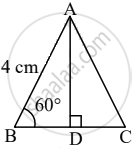
Let ∆ABC be the given equilateral triangle.
∴ ∠B = 60° ...[Angle of an equilateral triangle]
Let AD ⊥ BC, B – D – C.
In ∆ABD, ∠B = 60°, ∠ADB = 90°
∴ ∠BAD = 30° ...[Remaining angle of a triangle]
∴ ∆ABD is a 30° – 60° – 90° triangle.
∴ `AD = sqrt(3)/2 AB` ...[Side opposite to 60°]
= `sqrt(3)/2 xx 4`
= `2sqrt(3)` units
∴ The height of the equilateral triangle is `2sqrt(3)` units.
APPEARS IN
संबंधित प्रश्न
Construct a triangle ABC with sides BC = 7 cm, ∠B = 45° and ∠A = 105°. Then construct a triangle whose sides are `3/4` times the corresponding sides of ∆ABC.
The sides of triangle is given below. Determine it is right triangle or not.
a = 8 cm, b = 10 cm and c = 6 cm
A ladder 17 m long reaches a window of a building 15 m above the ground. Find the distance of the foot of the ladder from the building.
A triangle has sides 5 cm, 12 cm and 13 cm. Find the length to one decimal place, of the perpendicular from the opposite vertex to the side whose length is 13 cm.
ABCD is a square. F is the mid-point of AB. BE is one third of BC. If the area of ΔFBE = 108 cm2, find the length of AC.
In an acute-angled triangle, express a median in terms of its sides.
Calculate the height of an equilateral triangle each of whose sides measures 12 cm.
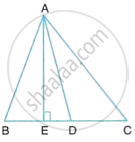
In the following figure, D is the mid-point of side BC and AE ⊥ BC. If BC = a, AC = b, AB = c, ED = x, AD = p and AE = h, prove that:
(i) `b^2 = p^2 + ax + a^2/4`
(ii) `c^2 = p^2 - ax + a^2/4`
(iii) `b^2 + c^2 = 2p^2 + a^2/2`
In ∆ABC, ∠A is obtuse, PB ⊥ AC and QC ⊥ AB. Prove that:
(i) AB ✕ AQ = AC ✕ AP
(ii) BC2 = (AC ✕ CP + AB ✕ BQ)
State the converse of Pythagoras' theorem.
Find the length of the altitude of an equilateral triangle of side 2a cm.
ΔABC ~ ΔDEF such that ar(ΔABC) = 64 cm2 and ar(ΔDEF) = 169 cm2. If BC = 4 cm, find EF.
A man goes 12 m due south and then 35 m due west. How far is he from the starting point?
Find the length of each side of a rhombus are 40 cm and 42 cm. Find the length of each side of the rhombus.
The co-ordinates of the points A, B and C are (6, 3), (−3, 5) and (4, −2) respectively. P(x, y) is any point in the plane. Show that \[\frac{ar\left( ∆ PBC \right)}{ar\left( ∆ ABC \right)} = \left| \frac{x + y - 2}{7} \right|\]
Find the side and perimeter of a square whose diagonal is `13sqrt2` cm.
A girl walks 200m towards East and then 150m towards North. The distance of the girl from the starting point is ______.
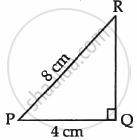
In the given figure, ΔPQR is a right triangle right angled at Q. If PQ = 4 cm and PR = 8 cm, then P is ______.