Advertisements
Advertisements
प्रश्न
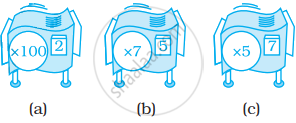
For the following repeater machines, how many times the base machine is applied and how much the total stretch is?
Advertisements
उत्तर
In machine (a), (× 1002) = 10000 stretch.
Since, it is two times the base machine.
In machine (b), (× 75) = 16807 stretch.
Since, it is fair times the base machine.
In machine (c), (× 57) = 78125 stretch.
Since, it is 7 times the base machine.
APPEARS IN
संबंधित प्रश्न
Mass of earth is 5.97 × 1024 kg and the mass of the moon is 7.35 × 10²² kg. What is the total mass?
The table shows the mass of the planets, the sun and the moon in our solar system.
| Celestial Body |
Mass (kg) | Mass (kg) Standard Notation |
| Sun | 1,990,000,000,000,000,000,000,000,000,000 | 1.99 × 1030 |
| Mercury | 330,000,000,000,000,000,000,000 | |
| Venus | 4,870,000,000,000,000,000,000,000 | |
| Earth | 5,970,000,000,000,000,000,000,000 | |
| Mars | 642,000,000,000,000,000,000,000,000,000 | |
| Jupiter | 1,900,000,000,000,000,000,000,000,000 | |
| Saturn | 568,000,000,000,000,000,000,000,000 | |
| Uranus | 86,800,000,000,000,000,000,000,000 | |
| Neptune | 102,000,000,000,000,000,000,000,000 | |
| Pluto | 12,700,000,000,000,000,000,000 | |
| Moon | 73,500,000,000,000,000,000,000 |
- Write the mass of each planet and the Moon in scientific notation.
- Order the planets and the moon by mass, from least to greatest.
- Which planet has about the same mass as earth?
The table shows the average distance from each planet in our solar system to the sun.
| Planet | Distance from Sun (km) |
Distance from Sun (km) Standard Notation |
| Earth | 149,600,000 | 1.496 × 10⁸ |
| Jupiter | 778,300,000 | |
| Mars | 227,900,000 | |
| Mercury | 57,900,000 | |
| Neptune | 4,497,000,000 | |
| Pluto | 5,900,000,000 | |
| Saturn | 1,427,000,000 | |
| Uranus | 2,870,000,000 | |
| Venus | 108,200,000 |
- Complete the table by expressing the distance from each planet to the Sun in scientific notation.
- Order the planets from closest to the sun to farthest from the sun.
This table shows the mass of one atom for five chemical elements. Use it to answer the question given.
| Element | Mass of atom (kg) |
| Titanium | 7.95 × 10⁻²⁶ |
| Lead | 3.44 × 10⁻²⁵ |
| Silver | 1.79 × 10⁻²⁵ |
| Lithium | 1.15 × 10⁻²⁶ |
| Hydrogen | 1.674 × 10⁻²⁷ |
- Which is the heaviest element?
- Which element is lighter, Silver or Titanium?
- List all five elements in order from lightest to heaviest.
Two machines can be hooked together. When something is sent through this hook up, the output from the first machine becomes the input for the second. Which two machines hooked together do the same work a (× 102) machine does? Is there more than one arrangement of two machines that will work?

Similarly, repeater machine is a hypothetical machine which automatically enlarges items several times. For example, sending a piece of wire through a (× 24) machine is the same as putting it through a (× 2) machine four times. So, if you send a 3 cm piece of wire through a (× 24) machine, its length becomes 3 × 2 × 2 × 2 × 2 = 48 cm. It can also be written that a base (2) machine is being applied 4 times.
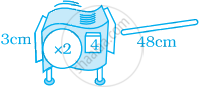
What will be the new length of a 4 cm strip inserted in the machine?
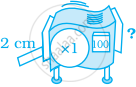
What will the following machine do to a 2 cm long piece of chalk?
Shikha has an order from a golf course designer to put palm trees through a (× 23) machine and then through a (× 33) machine. She thinks she can do the job with a single repeater machine. What single repeater machine should she use?

Neha needs to stretch some sticks to 252 times their original lengths, but her (× 25) machine is broken. Find a hook-up of two repeater machines that will do the same work as a (× 252) machine. To get started, think about the hookup you could use to replace the (× 25) machine.

A particular star is at a distance of about 8.1 × 10¹³ km from the Earth. Assuring that light travels at 3 × 10⁸ m per second, find how long does light takes from that star to reach the Earth.
