Advertisements
Advertisements
प्रश्न
This table shows the mass of one atom for five chemical elements. Use it to answer the question given.
| Element | Mass of atom (kg) |
| Titanium | 7.95 × 10⁻²⁶ |
| Lead | 3.44 × 10⁻²⁵ |
| Silver | 1.79 × 10⁻²⁵ |
| Lithium | 1.15 × 10⁻²⁶ |
| Hydrogen | 1.674 × 10⁻²⁷ |
- Which is the heaviest element?
- Which element is lighter, Silver or Titanium?
- List all five elements in order from lightest to heaviest.
Advertisements
उत्तर
Arrangement of masses of atoms in same power of 10 is given by
Titanium = 7.95 × 10⁻²⁶
Lead = 34.4 × 10⁻²⁶
Silver = 17.9 × 10⁻²⁶
Lithium = 1.15 × 10⁻²⁶
Hydrogen = 0.1674 × 10⁻²⁶
Thus, we have 34.4 > 17.9 > 7.95 > 1.15 > 0.1674
a. Lead is the heaviest element.
b. Silver = 17.9 × 10⁻²⁶ and Titanium = 7.95 × 10⁻²⁶, so titanium is lighter.
c. Arrangement of elements in order from lightest to heaviest is given by
Hydrogen < Lithium < Titanium < Silver < Lead
APPEARS IN
संबंधित प्रश्न
The table shows the average distance from each planet in our solar system to the sun.
| Planet | Distance from Sun (km) |
Distance from Sun (km) Standard Notation |
| Earth | 149,600,000 | 1.496 × 10⁸ |
| Jupiter | 778,300,000 | |
| Mars | 227,900,000 | |
| Mercury | 57,900,000 | |
| Neptune | 4,497,000,000 | |
| Pluto | 5,900,000,000 | |
| Saturn | 1,427,000,000 | |
| Uranus | 2,870,000,000 | |
| Venus | 108,200,000 |
- Complete the table by expressing the distance from each planet to the Sun in scientific notation.
- Order the planets from closest to the sun to farthest from the sun.
Two machines can be hooked together. When something is sent through this hook up, the output from the first machine becomes the input for the second. Which two machines hooked together do the same work a (× 102) machine does? Is there more than one arrangement of two machines that will work?

Two machines can be hooked together. When something is sent through this hook up, the output from the first machine becomes the input for the second. Which stretching machine does the same work as two (× 2) machines hooked together?
  |
Find three repeater machines that will do the same work as a (× 64) machine. Draw them, or describe them using exponents.
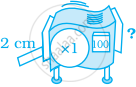
What will the following machine do to a 2 cm long piece of chalk?
Sanchay put a 1 cm stick of gum through a (1 × 3–2) machine. How long was the stick when it came out?
Ajay had a 1 cm piece of gum. He put it through repeater machine given below and it came out `1/(100,000)` cm long. What is the missing value?

Shikha has an order from a golf course designer to put palm trees through a (× 23) machine and then through a (× 33) machine. She thinks she can do the job with a single repeater machine. What single repeater machine should she use?

Find three machines that can be replaced with hook-ups of (× 5) machines.
The left column of the chart lists the lengths of input pieces of ribbon. Stretching machines are listed across the top. The other entries are the outputs for sending the input ribbon from that row through the machine from that column. Copy and complete the chart.
| Input Length | Machine | |||
| × 2 | ||||
| 1 | 5 | |||
| 3 | 15 | |||
| 14 | 7 | |||
