Advertisements
Advertisements
प्रश्न
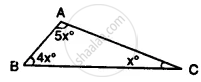
Find the value of the angle in the given figure:
Advertisements
उत्तर
In the figure,
∠A + ∠B + ∠C = 180° .....(Sum of angles of a triangle)
⇒ 5x° + 4x° + x° = 180°
⇒ 10x° = 180°
⇒ x = `(180°)/10=18°`
∴ ∠A = 5x° = 5× 18° = 90°
∠B = 4x = 4 × 18° = 72°
and ∠C = x = 18°
APPEARS IN
संबंधित प्रश्न
The angles of a triangle are arranged in ascending order of magnitude. If the difference
between two consecutive angles is 10°, find the three angles.
Can a triangle have All angles equal to 60°? Justify your answer in case.
If the bisector of the exterior vertical angle of a triangle be parallel to the base. Show that the triangle is isosce
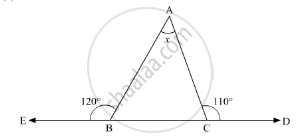
Compute the value of x in the following figure:
Fill in the blank to make the following statement true:
An exterior angle of a triangle is equal to the two ....... opposite angles.
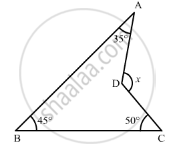
In the given figure, compute the value of x.
The angle of a vertex of an isosceles triangle is 100°. Find its base angles.
The length of the three segments is given for constructing a triangle. Say whether a triangle with these sides can be drawn. Give the reason for your answer.
9 cm, 6 cm, 16 cm
What is common in the following figure?
 |
 |
| (i) | (ii) |
Is figure (i) that of triangle? if not, why?
Can we have two acute angles whose sum is an obtuse angle? Why or why not?
