Advertisements
Advertisements
प्रश्न
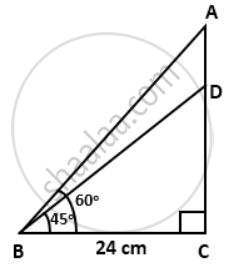
Find the length of AD. Given: ∠ABC = 60°, ∠DBC = 45° and BC = 24 cm.
Advertisements
उत्तर

In ΔABC,
tan60° = `"AC"/"BC"`
⇒ `sqrt(3) = "AC"/(24)`
⇒ AC = `24sqrt(3)"cm"`
In ΔDBC,
tan45° = `"DC"/"BC"`
⇒ 1 = `"DC"/(24)`
⇒ DC = 24cm
Now,
AC = AD + DC
⇒ AD
= AC - DC
= `24sqrt(3) - 24`
= `24(sqrt(3) - 1)"cm"`.
APPEARS IN
संबंधित प्रश्न
Calculate the value of A, if (tan A - 1) (cosec 3A - 1) = 0
If sin 3A = 1 and 0 < A < 90°, find cos 2A
Find the magnitude of angle A, if 2 cos2 A - 3 cos A + 1 = 0
Solve for x : 3 tan2 (2x - 20°) = 1
Find the value 'x', if:
Find the value of 'y' if `sqrt(3)` = 1.723.
Given your answer correct to 2 decimal places.
If tan x° = `(5)/(12) . tan y° = (3)/(4)` and AB = 48m; find the length CD.
In the given figure, a rocket is fired vertically upwards from its launching pad P. It first rises 20 km vertically upwards and then 20 km at 60° to the vertical. PQ represents the first stage of the journey and QR the second. S is a point vertically below R on the horizontal level as P, find:
a. the height of the rocket when it is at point R.
b. the horizontal distance of point S from P.
Evaluate the following: `(sin0° sin35° sin55° sin75°)/(cos22° cos64° cos58° cos90°)`
If tan4θ = cot(θ + 20°), find the value of θ if 4θ is an acute angle.
