Advertisements
Advertisements
प्रश्न
Find the correlation:
Group 13 to 18 : p block : : ______ : d block
Advertisements
उत्तर
Group 13 to 18 : p block : : Group 3 to 12 : d block
Explanation:
The d-block in the Modern Periodic Table consists of Groups 3 to 12. These elements are referred to as "transition elements" because they act as a bridge between the highly electropositive s-block metals and the electronegative p-block non-metals. In these elements, the last electron enters the d-orbital of the penultimate shell.
APPEARS IN
संबंधित प्रश्न
Fill in the blank:
The modern periodic table consists of ……………. periods.
Name two elements you would expect to show chemical reactions similar to magnesium. What is the basis for your choice?
In the Modern Periodic Table, which are the metals among the first ten elements?
where should hydrogen be placed in the modern periodic table? Give reason for your answer.
What is the name of those elements which divide metals and non-metals in the periodic table?
Consider the following elements:
Na, Ca, Al, K, Mg, Li
Which of these elements belong to the same period of the periodic table?
Consider the following elements:
Na, Ca, Al, K, Mg, Li
Which of these elements belong to the same group of the periodic table?
How would the tendency to gain electrons change on moving from left to right in a period of the periodic table?
What is the usual number of valence electrons in the atoms of the last element in a period?
What is the major characteristic of the first elements in the periods of the periodic table? What is the general name of such elements?
State how the valency of elements varies in a period of the periodic table?
On the basis of electronic configuration, how will you identify chemically similar elements?
Helium and neon are unreactive gases. What, if anything, do their atoms have in common?
An element X belongs to 3rd period and group 2 of the periodic table. State:
(a) number of valence electrons
(b) valency
(c) metal or non-metal
(d) name of the element
Define:
Periodic table
Name two elements in each case:
Actinides
Write a short note.
Position of isotopes in the Mendeleev’s and the modern periodic table.
What is meant in the periodic table by a period?
Two elements P and Q belong to the same period of the modern periodic table and are in group 1 and group 2, respectively. Compare the following characteristics in the tabular form.
- Number of electrons in their atoms
- Their tendency to lose electrons
- Their metallic characters
- Formation of their oxides
- Formulae of their chlorides
Give the symbol and valency of the following element and radical.
Chlorine [Chloride]
Fill in the blank:
The element lithium in the Modern Periodic Table with valency 1+ belongs to the group ______.
Name the following:
The group of the Modern Periodic Table to which calcium [Ca2+] belongs.
Answer the following question in one sentence.
The modern periodic table is divided into which blocks?
Write an explanation.
Period
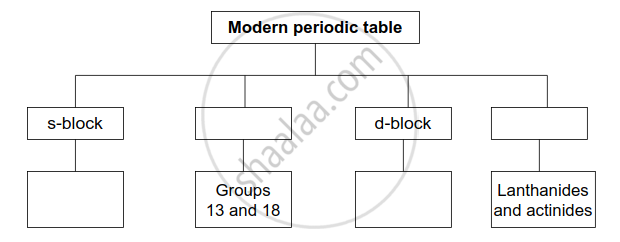
Complete the following flow chart.
Distinguish between:
Group 17 - Group 18
______ forms the basis of the modern periodic table.
How does the property vary in periods and in groups?
Identify gas A in the following experiment.

Which of the following statements about the Modern Periodic Table is correct:
Choose an element from period 3 of modern periodic table that matches the description given below in instance. Give a reason for your choice.
It has a similar structure to diamond.
Explain the position of hydrogen in the periodic table.
A part of modern periodic table is given below. On its basis, answer the following questions:
| Group No. → | 1 | 2 | 13 | 14 | 15 | 16 | 17 | 18 |
| Period ↓ | ||||||||
| 2 | A | B | ||||||
| 3 | E | D | F | C |
Which of the element is a Metalloid?
Give the criteria on the basis of which elements are placed (i) in a group and (ii) in a period in the modern periodic table. The atomic number of an element is 16. According to the criteria, in which group and period it should be placed?
Define periods of modern periodic table.
Answer the following in respect of element \[\ce{_16^32S}\].
Give its electronic configuration.
Answer the following in respect of element \[\ce{_16^32S}\].
To which group and period does it belong?
