Advertisements
Advertisements
प्रश्न
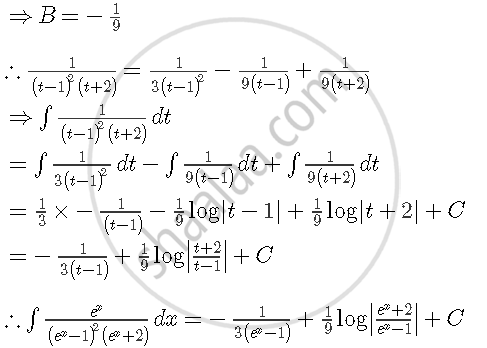
Find `int(e^x dx)/((e^x - 1)^2 (e^x + 2))`
Advertisements
उत्तर
`int(e^x dx)/((e^x - 1)^2 (e^x + 2))`
Putting ex = t and exdx = dt, we get
`int(e^x dx)/((e^x - 1)^2 (e^x + 2)) = int (dt)/((t-1)^2(t+2))`
Using partial fraction, we have
`1/((t-1)^2 (t + 1)) = A/(t-1)^2 + B/(t -1) + C/(t +2)`
⇒ 1 = A(t+2) + B(t−1)(t+2) + C(t−1)2 .....(1)
Putting t = 1 in (1), we get
`A = 1/3`
Putting t = −2 in (1), we get
C = `1/9`
Comparing the coefficients of t2 on both sides of (1), we get
B + C = 0
APPEARS IN
संबंधित प्रश्न
`int (dx)/(x(x^2 + 1))` equals:
Evaluate : `∫(x+1)/((x+2)(x+3))dx`
Find `int (2cos x)/((1-sinx)(1+sin^2 x)) dx`
Integrate the following w.r.t. x : `(12x + 3)/(6x^2 + 13x - 63)`
Integrate the following w.r.t. x : `(x^2 + x - 1)/(x^2 + x - 6)`
Integrate the following w.r.t. x : `(5x^2 + 20x + 6)/(x^3 + 2x ^2 + x)`
Integrate the following w.r.t. x : `(2log x + 3)/(x(3 log x + 2)[(logx)^2 + 1]`
Integrate the following with respect to the respective variable : `(6x + 5)^(3/2)`
Integrate the following w.r.t. x: `(2x^2 - 1)/(x^4 + 9x^2 + 20)`
Evaluate:
`int x/((x - 1)^2(x + 2)) dx`
Evaluate: `int (5"x"^2 + 20"x" + 6)/("x"^3 + 2"x"^2 + "x")` dx
`int "e"^(3logx) (x^4 + 1)^(-1) "d"x`
`int x^7/(1 + x^4)^2 "d"x`
`int x^2sqrt("a"^2 - x^6) "d"x`
`int "e"^(sin^(-1_x))[(x + sqrt(1 - x^2))/sqrt(1 - x^2)] "d"x`
`int (3x + 4)/sqrt(2x^2 + 2x + 1) "d"x`
Evaluate:
`int (5e^x)/((e^x + 1)(e^(2x) + 9)) dx`
`int xcos^3x "d"x`
`int (3"e"^(2x) + 5)/(4"e"^(2x) - 5) "d"x`
`int ((2logx + 3))/(x(3logx + 2)[(logx)^2 + 1]) "d"x`
Evaluate `int x^2"e"^(4x) "d"x`
`int 1/(4x^2 - 20x + 17) "d"x`
Evaluate the following:
`int_"0"^pi (x"d"x)/(1 + sin x)`
Evaluate the following:
`int (2x - 1)/((x - 1)(x + 2)(x - 3)) "d"x`
If `intsqrt((x - 5)/(x - 7))dx = Asqrt(x^2 - 12x + 35) + log|x| - 6 + sqrt(x^2 - 12x + 35) + C|`, then A = ______.
Evaluate:
`int (x + 7)/(x^2 + 4x + 7)dx`
Evaluate.
`int (5x^2 - 6x + 3)/(2x - 3)dx`
Evaluate:
`int(2x^3 - 1)/(x^4 + x)dx`
Integration by partial fractions is a method used to integrate which functions?
Which partial form corresponds to \[\frac{\mathrm{p}x^{2}+\mathrm{q}x+\mathrm{r}}{(x-\mathrm{a})(x-\mathrm{b})(x-\mathrm{c})}\]?
